Sunday, January 30, 2022

Anger is a Weakness

Angry businessman

On the business channel, CNBC, I recently saw an advertisement for an on-call flight service using private jets. It featured a frustrated businessman whose own jet had broken down. He was stamping his feet and shouting that he would be late for his “important business meeting.” Later, on having arrived at his destination, he was screaming for someone to tell him where all the taxis were. The point was that, if he had only signed up with the advertised service, he would always have a perfectly functioning plane at his disposal and a chauffeured vehicle waiting when he arrived.1

The reason I mention this is that, despite having his own private airplane and an important meeting to go to, this sample businessman came off as a ranting fool. His portrayal was presented as an object of fun, rather than an example of a serious business problem. After all, what is funnier than a red-faced man giving in to his anger? Or a woman with her face screwed up giving vent to her unhappiness? These are stock characters from the human comedy: the fool and the shrew, Punch and Judy.

The person who gets excessively, visibly angry or upset is a person out of control. Their emotions have gotten the best of them, temporarily overriding their reasoning mind and, to use a phrase from another culture, denying their “Buddha nature”—that is, their real, underlying sense of self. Worse, anger and upset are reactions, letting events and insults control you instead of controlling your own causal, social, and emotional environment.

On the flip side, what is more inspiring or calming than a person who can nod and smile and even laugh at adversity? These are the gestures and the disposition of someone in control of their surroundings and sure of themselves. The smile and laugh suggest that the person was wise enough to see adversity coming and to probably have a plan for dealing with it.2

Anger also makes you foolish. When taken to extremes, it can make you hasty and careless. You can overlook the lessons you’ve learned in the past, rush into action you’re not ready to take, and leap at conclusions about which you have not thought or deeply considered. Then you will have more to be angry about—anger at the situation, and angry with yourself for being a fool. Anger compounds weakness and destabilizes your life and your relationships.

The confident man or woman remains in control of emotions. They reserve anger for the true evil that should be righteously opposed, then use it as deep motivation in planning and executing right action. They love, but only when it is appropriate and may confidently be expected to be returned. They laugh, but only when the incongruity of the situation evokes shock and merriment, and then never hysterically. They don’t laugh when the shock and loss happen to another, because then the hurt is real and not at all funny.

We all admire a measured confidence. Not the confidence of the fool who has never been tested and knows no better, because that is truly sad. But the confidence of the person who understands life, expects it to both buoy them up and weigh them down, and who has a plan for either eventuality. When I was growing up, we called such a person “cool.”

Cool is not cold and uncaring. But it is the lack of heat, of visible anger or upset. The cool person moves through life dealing with crises, prepared with skills and reflexes that are appropriate to their situation, with knowledge and perspective that makes shock and surprise more difficult, that shields their inner nature from feeling wrong-footed and foolish.

In my day, this was the coolness of the secret agent, the undercover operative, the James Bond or Derek Flint. This was the person who functioned according to the words of General James Mattis: “Be polite, be professional, but have a plan to kill everybody you meet.” Maybe our admiration for such a person—someone who was living an intentional lie, sometimes with criminal accoutrements and intent—was misplaced. But we did aspire to the operative’s capability and general air of unflappability.

Giving in to anger is a weakness. It is a sign of the unprepared mind. It is small-minded and, to those of us watching from outside the situation, inherently funny. Moreover, it is physically and psychologically dangerous.

1. The ad never mentioned how much all this would cost, but I’m betting that I and my modest travel needs are not the target market. A fleeting glimpse of a screen shot suggested five figures, which is way too expensive for me.

2. Even if you don’t have the foresight to anticipate and plan for this particular adversity, the superior mind always expects some measure of trouble from some dimension. People of such a mind always have a backup plan, a work-around, an if-this-then-that on hand. They are seldom caught out by events. And they don’t get angry when events catch up with them.


Sunday, January 23, 2022

My Country, Right and Wrong

Freedom among the clouds

There is a lot of talk these days about this country’s past sins: slavery and pervasive racism, genocide of native populations, neo-colonialism in Asia and South America, and on and on. It would seem that a lot of people on the left side of the aisle dislike, even hate, this country and would like to see it “fundamentally transformed” into some kinder, gentler, meeker, more self-abasing place. Perhaps like Lichtenstein, but without Lichtenstein’s proud traditions and tax-haven status.

I come from the center of the aisle, with one foot on the right side of the carpet. I can acknowledge that this country has made some brutal, egregious decisions in the past and is not perfect today. But we still have done some good things. We rolled up our sleeves and fought in two world wars against expanding spheres of fascist influence in Europe and Asia that never would have impinged on us directly. We became a haven and refuge for immigrants from even before the founding of the nation as a whole, and we still welcome asylum seekers and those who want to make a better life. We are one of the few countries in this world that offer a complete life to those who will obey our laws but don’t want to assimilate to the American culture and give up their ethnic heritage—we celebrate their holidays as happily as our own. And after the last world war, as the sole remaining superpower, we tried to police the world’s little warlords and rebuild our allies and enemies, instead of occupying their territory and carting off their national and cultural wealth.

We are, as I’ve written before, a nation of immigrants and stronger for that. Even the prehistoric people who walked here across the Bering land bridge and past the glaciers, even those who were brought here against their will and in chains—and were strong enough to survive and hope—have found a way to build a better life for themselves here than in the places they came from. And those who sailed either of two great oceans and landed here of their own free will represent the bravest, smartest, strongest, and most determined of their native lands’ populations. They are the self-selected individuals who did not want to put up with one more war, one more tax, one more pogrom, one more landed aristocrat or insulated bureaucrat carelessly making decisions about other people’s lives. In every case, we got—and still get—the strong ones.

Our national character—the core of our aspiration, not the fringe pattern of our separate ethnic embellishments—reflects this. Americans one and all are optimists. We are determined. Yes, we are sometimes careless ourselves. And sometimes we are bumptious and gauche in the eyes of European and Asian sophisticates who live in older, more settled cultures. But we are busy inventing and building a new world that sometimes only we can see.1

Yes, we made mistakes, and we’ll make plenty more in the future. To quote a line from my corporate days, “If you want to increase your success rate, increase your failure rate.” That is, if you’re not making some mistakes, you’re not trying hard enough to achieve your potential.

Am I bothered by the negative comments about my country? Oh, some. If people hate America enough to scrap everything and start over, then I am saddened—especially if they pick the dormant economies and collectivist cultures of Europe or Asia as their role models. Marx was a fool, and utopian socialism doesn’t paint an exciting future even as a selfish child’s dream.2

But the ability to acknowledge past wrongs and work to make them better is a strength. In the past sixty years, the majority of my working life, we have initiated a sea change in this country to adjust attitudes towards and provide opportunities for neglected Native Americans, African Americans, and other racial and ethnic minorities. This is a sign of strength. It reflects the generous spirit that infuses the American conscience. While we’re busy building that new world, we extend a hand to those we think might not have caught up with where we’re going. And that is all good.

So, not perfect. This country is not all wrong, not all right, but somewhere in between. Although I am leery of comparisons between individual and national characters, I think this one fits. We are, as a people, on the whole, a fairly good country. We’ve made mistakes, and we’re aware of them. We’re trying to do better. And we’re looking to the future with hope.3

That’s healthy in both a person and a country. Or so I believe.

1. You want examples? We give more in charitable giving than other countries. There, people might take care of their families, but they expect the government to take care of the others. Here, people support domestic charities like Habitat for Humanity and foreign organizations like Doctors Without Borders, as well as local groups like the neighborhood YMCA and Boys and Girls Clubs. We give money to strangers, as attested by the people who sit at the bottom of freeway offramps with signs saying “Help—Hungry” and find it pays well enough to keep coming back.
    We volunteer more than other countries, too. From the traditional barn-raising to the people who volunteer each September to clean up rivers and beaches in Coastal Cleanup, we pitch in. My late wife used to volunteer at Marin County’s Marine Mammal Center as part of their Monday Day Crew, shoveling seal dung out of the pens, mixing fish mash, and intubating sick and dying animals. This was hard, dirty—but rewarding—work. A Dutch veterinarian who came there to study the seals and sea lions commented to my wife that you didn’t see such volunteers in Europe: some women might come in to pet the animals, she said, but not to clean up after them.

2. Marx’s vision of the future was a tribal barter economy—or the feudal castle without the feudal lord—writ large. It is totally inadequate in a nation-state of hundreds of millions of people spanning an entire continent, as the Russians found, and the Chinese are discovering. My old quip is that “Marx is to economics as phlogiston is to chemistry.” That is, pre-intellectual nonsense.

3. One final personal reference. I was talking with a man who was raised in Eastern Europe, Czechoslovakia, where in his youth everyone looked east to the Soviet Union. He said that no one feared the United States, not because we are weak but because we didn’t want to take over anyone. But everyone feared the Russians.

Sunday, January 16, 2022

General Will

Show of hands

The French philosopher Jean-Jacques Rousseau popularized the term “general will” (volonté générale) to represent the desires and intentions of a community or nation as a whole. This is supposedly the embodiment of a collective consciousness that exists, makes decisions, and expresses demands apart from the individuals living and working in that community or nation. If you can just find and express that “general will,” then politics becomes so much easier. Stick with the popular opinion, and you can’t go wrong.

I don’t believe it. I don’t believe there is such a thing as “general will” or popular opinion or collective consciousness above, beyond, and overriding what individuals decide and do. Minds are individual things. People’s brains are isolated inside a bony box, communicating with the outside world through spoken words, printed and electronic messages, and seen and remembered images. But their thoughts are private and ultimately powerful in deciding what a person will do. Or so I believe.

This is not to say there aren’t some beliefs that most people in a community or nation share, notions they were born into, reflecting the culture established by their parents and grandparents. Everyone is shaped by their family and tribe, the church or party their tribe belongs to, and the values learned at their “mother’s knee.”

The lucky ones are also taught enough caution and skepticism that they eventually question everything, including the “home truths” with which they were born. That is the great thing about the human mind: it can hold two or more opinions at once, weight them, evaluate pros and cons, chances and likelihoods, and reflect on personal experience to decide which opinion is more congruent with perceived reality. And that’s all anyone has, because “ultimate truth”—aside from obvious, empirical conclusions like “water is wet” and “fire will burn”—is not promised to anyone.

And this is not to say that ideas are not floated in a community or nation by popular influencers, political parties, and the news and social media. It happens all the time. And in the last decade or two, it happens more and more, now that the internet makes available many more pieces of information—good and bad, hopeful and hateful—which people in general can then either accept and prize or reject and despise. But that acceptance or rejection is still subject to individual thoughts, desires, acculturated understandings, and personal whims—all of which occur within that bony box.

But the thing about consensus notions and any actual “general will” is that they are … general. That is, they are not specific and do not actively support any particular program or prescribe its parameters. Those specifics are open to interpretation, weighing, evaluating, and other acts of individual thinking.

Yes, Western Civilization has been on an upward moral path in the past couple of centuries, ever since the rationality of the Enlightenment tempered the religious fervor of the Reformation. People—or at least those who read, write, and think—are more inclined these to a broader view, with more tolerance and generosity, more caring for the social good than the simple me-and-mine of family and tribe. This is not something you see in many other parts of the world. But that generous, tolerant spirit is still not a prescription for any one program of welfare payments or public health care. People are still able to weigh the costs and benefits, evaluate the subtle impacts on personal responsibility and motivation, and argue about specifics.

Rousseau’s volonté générale is an interesting idea in the abstract. It is suitable for being theorized about and debated by philosophers and academics. It belongs on the syllabus, along with economic and cultural Marxism and Freudian psychiatry, as an artifact of philosophical thought. But it is a poor thing upon which to base a real-world approach to politics and social order. That way lies madness.

Sunday, January 9, 2022

Politics on the Front Porch

Mount Vernon

I’ve been thinking for a while that things in these United States have gone—well, not wrong, but somewhat askew. This is not the fault of any particular party or politician. And it’s not an inherent flaw in our Constitution or the setup of our government. But the problem bothers me, and I think about it.

The issue may be that no one governmental structure was ever meant to fine-tune the control of a nation of 330 million people from dozens of ethnic traditions in an area that spans four time zones across an entire continent. This is just too big a job for any emperor, monarch, or president and his—and maybe her, eventually—administration. Europe has tried for three decades to be a unified place, but it remains a patchwork of individually governed countries under the fairly weak umbrella of a centralized union and common monetary scheme. China, for all its monolithic aspect, basically manages affairs at the province level with only policy suggestions handed down from the central government in Beijing. Yes, the Chinese Communist Party is invested in the central and all local governments, providing a unified vision, such as it is, but day-to-day internal processes are local.1

Perhaps the only long-term, centralized governments that ever worked were those of the Romans around the Mediterranean and the Mongols in Central Asia. But both of those allowed a large measure of local control and administration. And both of them ended up fragmenting into smaller empires with a decidedly ethnic flavor.

In the United States, the vision of the original founders was a union, not an all-encompassing national government. The states would take care of most internal decisions to suit the needs and desires of local populations—which in the original founding often came from different parts of Europe with different customs and expectations. The federal government would manage just a few functions like national defense, foreign policy, and interstate commerce. And that worked for most of the 19th century, with exceptions like the turmoil of the Civil War. For most of that time, the federal government survived on funding from tariffs and excise taxes—think of the Whiskey Rebellion in the 1790s. There was no federal income tax until 1913.

But then, under the push of progressive and liberal presidents like Wilson, Roosevelt, and Johnson, reacting to both internal and external stresses that they could see no other way of managing, the federal government grew. It extended its reach downward into affairs that used to be left to local decision-making. The executive power of the president expanded the complexity of administration and added cabinet posts for oversight of functions such as energy, education, and health that were never mentioned in the Constitution. And the Federal Reserve, which is a separate organization but operates under the federal government’s wing—with its chairman appointed by the president and approved by the congress—now takes responsibility for the control and orderly functioning of banking and the national economy.

Article 10 of the Bill of Rights, appended to the U.S. Constitution as originally adopted, grants the federal government only those powers described in the original text and, presumably, its subsequent amendments. The rest of the governing function is reserved to the states and to the people. But, as noted above in the instances of things like energy, education, and health, the federal government today makes decisions, writes laws, and issues regulations—which have the force of law and are adjudicated in the courts—far beyond the original enumerated powers.

For much of this—the legal underpinning, if not the political urging—we can blame the Interstate Commerce Act of 1887. It was based on the Commerce Clause in Article 1, granting the federal government power “to regulate commerce with foreign nations, and among the several states, and with the Indian tribes.” The act was intended to regulate the railroads, which conducted business in several states and across state lines, and which were effectively ungovernable by any single state or by the conflicting laws of the various states where they operated. But that commerce clause has been expanded again and again, and it now governs almost any organization or enterprise that operates across state lines—which in a large and busy nation includes almost any function larger than a mom-and-pop grocery store.

Was this a weakness in the original Constitution and its intended creation of a union with limited governing power among strong and vibrant states? Or has it been exploited by politicians with a hunger for power on a wider—a nationwide—stage? And, as a corollary, could the small and limited national government of the pre–Civil War days have functioned effectively as a superpower on the international stage in the power vacuums left by the First and Second World Wars? I can’t answer those questions. But the thing is already done.

And still … in a way … the government that we have now is something like a jerry-rigged structure. It is as if someone had taken the front porch of a house—even one that extends around both sides of the house—and tried to turn it into the main structure and dominant living space. You can imagine the amount of new foundation supports, insulated wall construction, door and window installation and glazing, plumbing and electrical work, not to mention the planning and creation of new rooms and their assigned functions, that would be required to make this a success. Otherwise you would get a patchwork, a hodgepodge, and a lot of arguments and disappointments about how things are apportioned and whether the whole thing works at all.

But that’s what we’ve got. And the situation is made worse because congress has ceded its obligation, under the Constitution, to write effective and specific laws. These days, knowing that the administration’s various departments will work out the details, congress writes large, loopy acts running to thousands of words—sometimes thousands of pages—filled with wish fulfillment and desired end states. The real business of governing on the ground is then left up to the executive branch: the president and the cabinet departments that report to him—or maybe her, eventually.

This concentration of power starts to look a lot like an autocratic body, the domain of an emperor or king and the court of ministers and clerks that support the imperial or monarchical will. That’s not a good way to go, because as noted above, empires like those of the Romans and the Mongols eventually collapse.

But we might have a few hundred years of autocratic and hereditary rule to experience before that happens.

1. How do I know this? Because I’ve worked at companies that have had, or tried to have, dealings with China. The national ministries are more like think-tanks or policy-making institutions—functioning like our Centers for Disease Control and Prevention—than actual governing bodies issuing regulations and executing business decisions like our Environmental Protection Agency or Department of Education. And when you ship products into China, you often have to change package labels and pay new tariffs when transshipping from one province to another. Vision in China is central; control is local.

Sunday, January 2, 2022

Janus, God of Doorways

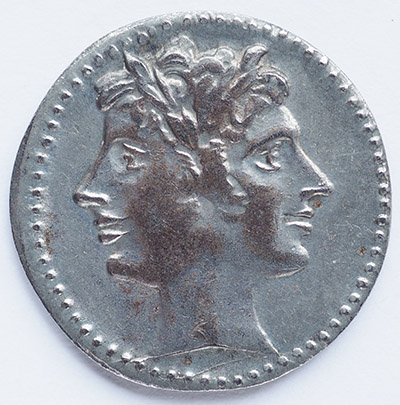
Janus coin

Well … it’s the New Year, 2022. Anymore, after the last two years, in reaching this calendar change I feel like an exhausted swimmer putting my hand on the pool coping tiles after completing far too many laps. The hope is we get a respite, an easy year, no excitement, with a pandemic that becomes something familiar and relatively tame like the flu, with a supply chain that unsnarls itself, with inflation that subsides as the economy continues strong and those supplies keep comping, and with the saber-rattling easing over the Ukraine and Taiwan. Well, I can hope.

The date and the month have me thinking about that peculiar name, “January.” It comes from Janus, who was the Roman god of doorways, gateways, passages, transitions, and similar movements from one thing to another. He is always depicted as having two faces, looking forward and also backward. Forward to the new year, backward on the old. We show something similar in our more modern cartoons around this time, of the past year depicted as a tired old man, the new year as a smiling, bouncy baby. Or at least I hope the baby is smiling.

Janus is also where we get our world “janitor.” In ancient times, among the better families who tended to shape language, every well-equipped house had someone who answered the door and announced guests—and likely had a bit of physical strength and prowess to block the door and bolt it against assailants and vagabonds. In more recent times, this person would be the butler or—if you’re an aficionado of Downton Abbey—perhaps a footman. In either case, the janitor was an important member of the household, because he would guard the door, admit friends and guests, and turn away political enemies, beggars, and robbers. It was a job with a lot of discretion.

In the last century, the job of janitor has morphed into someone employed by an institution—a school, hospital, or commercial establishment—to perform routine cleaning, pick up obvious trash, and attend to the messes that the inmates and visitors create. And that seems pertinent to the end of the past year: we’ve got a lot of messes that everyone is pointing to and complaining about, but no one seems to be cleaning them up.

Janus is the god of transitions, of moving from one state to the next, and incidentally picking up the litter that the previous events have left behind. Every former state or condition leaves its mark in broken promises, dashed expectations, scattered confetti, dirty plates, and torn paper. Before you can move on, the god of transitions has to look back and clean up the former mess.

Something in the human brain wants a fresh start every so often. That tends to include a good nap, a hot bath or shower, a solid meal, and a cup of coffee. At the same time, we reflect on what has just happened, what we have been through, what personal decisions we make about the experience, and how we would like to remember it. That’s the way we put things behind us, brighten up, manage to smile, and get ready to charge ahead into the next crisis or challenge. And here, too, Janus is our guiding spirit, looking backward and looking forward at the same time—the god of passages and transitions.

And so we head into 2022 after a relaxing New Year’s Day, with a nap, a meal, and a cup of coffee. I only wish I didn’t hear in my head a paraphrase of that Bette Davis line in All About Eve: “Fasten your seatbelts. It’s going to be a bumpy ride.”

Sunday, December 26, 2021

The World in Pictures

View camera

Scrolling through Facebook—and occasionally dipping into the clickbait topics associated with it, particularly those before-and-after comparisons of the actors and actresses of my youth—I had a sudden inspiration: our world is measurably different since the invention and widespread distribution of the personal means of photography.

Taking photographs, especially in the early days, used to be a learned skill. To practice photography successfully, you needed a good camera, some understanding of film speeds, f-stops, aperture settings, and light conditions. And if you weren’t going to go broke getting your negatives and prints developed at the drug store, you had to build a darkroom, invest in an enlarger, buy a stock of specially treated paper, and become something of an amateur chemist. I know all this because my grandfather was a dedicated photographer, and he gave the bug to my brother, who sealed off one room in every house we owned and infested it with the vinegar-and-rotten-egg smell of developer and fixer. Since then, he’s invested a goodly portion of his disposable income in better and better cameras and a variety of lenses to fit them.

Everyone else, these days, uses an application that comes free with their smartphone and is built around a lens no bigger than a grain of sand and a photo chip to match. People routinely, or so the meme goes, photograph their lunches and send them to friends on social media. And along the way, they capture every stage of their children’s development, of their home renovation, their latest road trip, and whatever they can see out the window of a bus. Those with access to an old family album—or someone like my brother—will also post pictures from decades ago when their grandparents were young and hot and in love.

Think of what our future will be! One day soon, you won’t have to dig out a dusty old album or box of prints from the attic and hunt through them to make those comparisons. Instead, you will have your entire family and the highlights of your life catalogued year by year, sometimes day by day, to pull up, enjoy, and relive.

But now I imagine a time before even the dedicated family photographer or the studio professional, capturing those key moments like Christmas mornings, weddings, and birthdays for us to keep in our hearts forever. That time goes back to … when? Certainly before the 20th century. You can pick 1888, when George Eastman developed and marketed the first simple box camera using celluloid film under the brand name Kodak. Or the Civil War years, when Matthew Brady visited battlefields and encampments with his view camera that recorded on glass plates, which themselves required a whole wagonload of equipment to store and develop. Or back to the 1830s, when Louis Daguerre experimented with exposing copper plates that had been treated with a vapor of silver iodide to make them light sensitive, eventually producing the first “photograph”—or, from two Greek words, “light writing.”

Before that, if you wanted to capture the image of someone or something, you hired a person with skills in drawing, color mixing, and painting. That meant you put up with that person’s peculiarities of vision and perception, distortions from their own imagination and personal biases, the speed at which they were willing to work, and their other competing clients and interests. You could hardly capture an event or a moment at your discretion unless it was hurriedly sketched or carefully staged before the final application of paint to canvas for the full-color effect.

That is, if you wanted to document the people or events in your life, you were either royalty or immensely wealthy. For the rest of us, events happened and then disappeared forever, captured only in memory and imagination, or perhaps with a description in our own or someone else’s diary. People aged before our eyes, and we had only our memories of their faces to compare with the day-to-day reality in front of us. We couldn’t laugh or marvel at the clothing styles that our grandparents had thought fashionable unless they laid the actual articles in a trunk for us to discover and try on decades later.

For most of us, the world lived in a perpetual now. Our sense of history came from our parents’ memories and what we could read in books—accepting, once again, the distortions of the author’s imagination and biases. Things happened, and then they became part of an ever-fading yesterday that lost relevance even as you thought about it. People lived, grew up, flourished, grew old, and died, but all you ever knew about them was the person who happened to be standing in front of you in the current moment. It was a world with a lot less to think about and compare. It was a world with a fragile human memory, some dusty books, a few mementoes in trunks, and a gallery of paintings about other people.

Do we live in a better world now? Today we can access high-resolution pictures of the lunch we had three years ago. We can relive every birthday and Christmas morning even after most of the participants are dead. We can—now that our smartphone records not only still pictures but also full minutes of action with video—live in the event. We can do everything but speak to the dead and change, for better or worse, the moments we are watching.

Is that better? Or are we forced out of the now and into the remembered channels of fond feelings, lost hopes, and sometimes bitter regrets? I don’t know. I would ask my brother, but right now he’s too busy capturing and processing the moments themselves.

Sunday, December 19, 2021

Transitions and End States

Lotus flower

I’m probably going to get in trouble for saying this, but I think Buddha was wrong. Or at least the main teaching of Hinayana—or “Lesser Vehicle”—Buddhism, that the goal of meditation and right life practices is the state of enlightenment, is wrong. Any final end state of understanding, where all knowledge and precepts are fixed and nothing more can be attained, is simply not part of the human experience. And no, the bodhisattvas are not some other form of being, some kind of supermen, but just regular human beings who have trained their minds in certain ways of thinking.1

In my view, all life—human life, animal life, evolution on this planet, and by extension the life cycles of stars and galaxies—is transition. So long as you are alive, you are engaged in a process. It starts with the combination of egg and sperm and the first unraveling of the embryo’s DNA to create differentiation and development of specialized cell types. It ends with the failure of major organs that support cellular metabolism and the dissolution of the body’s tissues. Everything in between is process and change.

In the same way, stars begin when enough dust and gas collect in one place through electrostatic attraction, the collapse into a compact mass through the attraction of gravity, and the ignition of a fusion reaction through internal pressure. It ends with the exhaustion of fuel, and the final collapse into a neutron star or black hole. Everything in between is process and change.

In both cases, the only end state is death, the stilling of all processes, the unchanging forever of nothingness. Dead people cannot be detected or resurrected as dust and component atoms. Neutron stars can only collect more dust and mass, changing regular atoms into a jostling compaction of stripped neutrons, until they reach enough mass to disappear into a black hole and never be seen again, except for the effects of gravity.

Human beings with their subtle brains seem to long for a living end state. A final attainment of enlightenment, complete understanding, with nothing more to experience, no doubts, nothing more to endure, no reason ever to change again. This is a fantasy.

You can no more learn all there is to know—or all that’s important—and stop thinking than you can flap your arms and fly like a bird. You might be able to believe your brain has stopped because you have temporarily shut out the mutter of background thoughts that come with the firing of random synapses outside of your conscious, focused attention.2 But even if you are very strong-willed, sooner or later the environment or your body’s needs will interrupt the silence. You will ask, “What’s that noise?” or “What’s for lunch?” And the processing of inputs and answering of questions begins all over again.

Serial enlightenments are possible. You can learn new things, resolve certain questions, gain sudden understanding of truths that have long been hidden from you. You can have insights and “Aha!” moments. But none of them will be the complete answer. None will stop your thinking and questioning, provide the perfect understanding of all things—or even just the things that are temporarily important to you—and free you from the need to think, doubt, or decide ever again.

In the same way, human societies seem to hunger for a final state of organization. A revolution that will bring on a subline method of government supplying all human needs to all people, with no dissatisfactions, no failures of equality and personal respect, no cases of privation or indignity. Plato’s Republic was ruled by philosopher kings who could make no mistakes. Communal societies are set up so that every member works selflessly and joyously for the good of all. And these are supposed to be the “end of history,” because the dissatisfactions and disruptions that make up most of the historic record—think wars, famines, invasions, market crashes, and other disasters that require dating and analysis—will no longer play a part in human life. Instead, everyone simply enjoys one long, golden summer’s afternoon, like Odysseus among the Lotus Eaters.

But, as noted above, a human being—a body of cells in process, inhabited by a mind active with synapses firing away—never reaches a state of perpetual understanding and satisfaction. And if one human can’t do it, then all of them at once will never do it. Life is change. And the cessation of change is death.

1. And, actually, I am not being quite accurate here. In the Buddhist teaching, bodhi or enlightenment is valued because it supposedly stops the karmic cycle of rebirths to higher planes of existence, if you’ve been good, and to lower planes, if you’ve been bad. Instead, when you die you go to Nirvana, which is a place of endless meditation, like Heaven without the halos, wings, and harps. Bodhisattvas are supposedly those who have already attained enlightenment, could retire to Nirvana themselves if they wanted, but have chosen to stay behind and help others along the path. Of course, if you don’t believe in reincarnation and the transmigration of souls, but instead think that when you die you just “go out, like a candle flame”—to use the Buddha’s own metaphor—then … what’s the big deal?

2. See Working With the Subconscious from September 30, 2012.