Sunday, July 26, 2020

Created Equal

Declaration of Independence

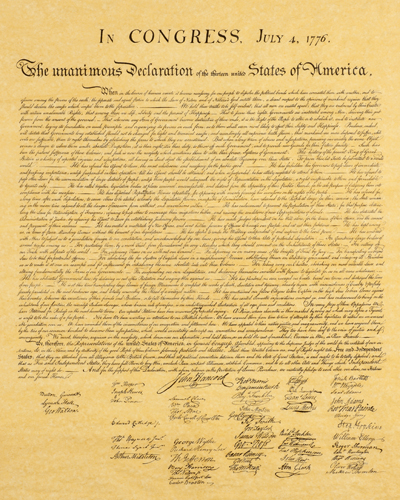
You know where in the Declaration of Independence, in the second paragraph, it says, “We hold these truths to be self-evident, that all men are created equal”—I have always stopped right there.

To me, this is not a self-evident truth but fatuous nonsense. No two persons are or ever were equal. One or the other is always going to be bigger, stronger, faster, smarter, shrewder, more handsome, more sexual, more adept with women, better able to handle his money or his liquor, better at cards, better at life. No two things in this universe, not two stars or planets or galaxies,1 were ever “created equal.” So, for a long time, this statement—at the core of the Declaration—puzzled me.

But the idea of equality encompassing all these characteristics is actually a late 20th- and early 21st-century notion. To understand what Jefferson was writing about, you have to see this statement in terms of 18th-century suppositions2 and pay close attention to the clauses that follow.

The 18th century was a time when people were presumed to be divided at birth between nobles and commoners, lairds and crofters, lords and serfs, “the better sort of people” and “the rest of them.” This was a given: that a man (or woman) was born into a certain station in life, and that for a person to rise out of it—or fall from it—was a remarkable thing. “Rising above your station” was also contrary to God’s preordained intentions, because it was God who put you there in the first place; it was part of His plan for you. Changing one’s position in life violated the “Great Chain of Being”3 and was unheard of in the Europe of the Middle Ages and even into the Renaissance. People and their classes were fixed for eternity. But by the 18th century, in England at least, a prominent person of rather humble birth who had done good service to the crown or the nation as a military officer or politician might be granted a baronetcy, which ranked him as a minor lord equivalent to an old-fashioned knighthood with the privilege of hereditary transference. Sort of a back door into the club.

But in the American colonies, where people with actual noble rank were only visitors and not cast upon the distant shore to make their way or die, elevated station was not gained through inheritance—or not at first, and not officially—but rather as the product of holding large amounts of land as a scion of the early settlers or making or inheriting vast amounts of money in trade. And such holdings, along with their unofficial rank or status, could just as easily be lost through stupidity, ill fortune, or a bad turn at cards. By 1776, the notion that some people are born better than others, rightfully holding a higher station in life, favored by God, granted rights and privileges to which the common run of humanity was not entitled—well, that Old World view was pretty much blown. Or that was the mindset of the radicals of the time: Jefferson, Washington, Adams, and everyone else looking to start a new country on this continent.

And so we come to the clauses that follow: “that they are endowed by their Creator with certain unalienable Rights, that among these are Life, Liberty and the pursuit of Happiness.” And that’s the nut of it. A free man on American soil was not a peasant to be bound to the land or ridden down on the road by a lord on his high horse. He was free to work where he wanted at the thing that made him happiest.4And it was hard to hold a man at a job in town or on the landlord’s farm when the whole colony occupied only the easternmost fringe of coastline—penetrating only one or two hundred miles inland—on a continent that spanned three thousand miles. Anyone dissatisfied with his lot could easily pick up an axe and a hoe, walk off into the woods, come to the first empty clearing, and start farming for himself.

So the Americans of the mid-18th century, the time of the Declaration, did not see themselves as anything less than King George, their lordships of Old England, or members of the Parliament that made rules for their American colonies. Americans were not of lesser station or deserving of less consideration or fewer rights because of their humble or obscure heritage. But at the same time, the concepts of life, liberty, and happiness embedded in the Declaration were understood to ensure only a person’s equal treatment under the law, which granted him or her equal rights and privileges. But the Declaration never meant to guarantee equal expectations and outcomes in life, because each person has to make those for him- or herself.

The distinctions between noble and commoner—or indeed between white European and black African—that weighed so heavily on the minds of 18th-century thinkers have now been worn away by two and a half centuries of actual judicial equality. For most Americans, our shared humanity is a simple matter of personal enlightenment in a society that already values equality. We have made a society where all men are truly equal before the law—or at least that is our stated intention, since the Civil Rights Act of 1964. And so the class and judicial distinctions that impelled the language of the Declaration no longer exist for us. This leaves the present-day reader free to imagine other, perhaps deeper meanings for the word “equal” in that context.

The old class system in England and in Europe generally—between the peasant and the lord—were systems to confer and maintain advantage and power. The families that attained leadership positions in the neighborhood or as adherents to the king, or those with large landholdings—usually the same thing, as land was generally gifted by the king as a remnant of feudal times—maintained these rights by passing them down to their sons and occasionally through their daughters. Noble titles usually accrued to such positions of power, and eventually the inherited title came to mean something even after the political power or the land and money were gone.

In America, although a person might be born into low station, that guarantee of liberty and the pursuit of happiness allowed the individual to pursue and maintain large landholdings—remember those three thousand miles of open land stretching to the Pacific Ocean—or earn vast fortunes through enterprise and industry. And the 19th and 20th centuries were a time of huge technical advances in mechanics and energy, which enabled many entrepreneurs to build great wealth, just as the late 20th and early 21st century now provide opportunities in cybernetics. By passing the wealth down through sons and daughters, wealthy dynasties not much different from European nobility have been built.5

But now, with a new reading of that “created equal”—focusing on the desirability of equal expectations and outcomes—the American spirit seems to want no inequality. There should be no systems of power, no wealth to be made for oneself and one’s family by hard work, prudent saving, and shrewd investment. The government, it is presumed, will see to it that everyone prospers equally, shares equally in the goods and services created by society—not by individuals or corporations or inspired inventors or from the fruits of personal labor, but by the faceless forces of society as a whole. That way, no one gets more than anyone else, and we will all be equal in fact as well as under the law.

Of course, that’s poppycock. Marx may have imagined that, after a brief struggle under the dictatorship of the proletariat, the state would eventually wither away, and everyone would settle into joyously producing according to his abilities and contentedly consuming according to his needs—forever. But Marx was a madman. In reality, in a nation with a large and diverse population and variously located farms and factories, and long-distance logistics, someone has to operate the distribution system, decide whose needs will be met, in what order, and when. That, my dears, is a position of power. And people with power will tend to profit by it and want to pass it along to their sons and daughters. It is in our human nature. That impulse created the new nobility of the Nomenklatura in the old Soviet Union and the ranks and privileges of Party members in every other socialist totalitarian state.

You can no more eliminate the concept of power from human society than you can eliminate sex or hunger, envy or greed. You can dampen the notion of ambition and make it generally distasteful to a large swath of the population. But someone will notice that the reins are flopping around on the horse’s back and take it upon himself to reach for them. That is in our nature, too.

So long as people are born with differences in the characteristics that count in life—some being smarter, some shrewder, some with more energy, or talents, or just with different dreams—equality in expectations and outcomes will remain a phantom, a figment, a madman’s goal, a utopia never to be found under heaven.

1. Except maybe for subatomic particles—like protons, electrons, and neutrons—but even there modern physics is having doubts about the construction of the Standard Model of quantum mechanics.

2. We also have to get over our modern feminist principles and the visceral reaction to that reference to “all men.” In the 18th century, the differences—or lack of them!—between the sexes and their roles in family and public life were not questioned. “All men” was not read as a distinction from or exclusion of women, but instead the phrase encompassed mankind—what we now are taught to call “humankind”—and the species H. sapiens generally.

3. The Great Chain of Being was a medieval Christian construct, intended to order the universe and everything in it from God Himself (the highest level) down through the ranks of angels, the classes of humans, then animals in the order of their natures and station in the food chain, next the plants, and finally the minerals (the lowest). Without a working knowledge of physics, chemistry, biology, and genetics, it was one way to bring structure to chaos and to keep the scholar’s mind busy.

4. Of course, indentured servants and chattel slaves were different, although early in the next century, if not in the 18th, people were beginning to question that assumption.

5. With the difference that these holdings can be lost through stupidity, changes in the marketplace, or a bad turn at cards. If you doubt this, ask yourself what has happened with the heirs to the Carnegie, Ford, or Kaiser fortunes. The pattern in this country is for an industrial empire to be built by an innovative entrepreneur, managed by the second generation or converted to a publicly traded corporation under a board and appointed managers, and if not converted, then generally lost in the third generation—unless the resources are put into a foundation, such as those of Carnegie and Ford, and managed for some public good.


Sunday, July 19, 2020

On Respect

Helping hand

It has long been a key demand of people who describe themselves as being in some kind of lesser social position that they must get “respect.” What they mean by this is not exactly clear to me. Do they want recognition by total strangers of their innermost and sometimes hidden talents and skills? Deference to their inner sense of excellence? Special treatment because of their reduced situation? Special treatment because of past injustices? What?

I am not prepared to give anyone unknown to me any kind of special treatment. That is, I reserve intimacy, generosity, understanding, and the willingness to be discomfited and indisposed only to my friends and family. To all others I offer payment in cash—and at arm’s length.

But what I am willing to extend to strangers on the street is a limited form of good will. And this involves a small number of unremarkable acts and gestures.

First, I will show the stranger my own form of courtesy, including the performance of small favors. Courtesy is represented by brief eye contact and a polite smile. A small favor would be holding the door open for someone whose hands are full, or holding it after I pass through so that it does not slam in the face of the person behind me. I will also step to one side on a narrow path to allow another person to pass without hindrance. In traffic, I will let the driver in the other lane make his or her turn, or cross the intersection when it is unclear who arrived at their stop sign first, or who holds the privileged position of being “to the right” (a California specialty). And on the freeway, I will not speed up to get ahead of someone coming up the on-ramp and trying to merge—in fact, I will even move one lane to the left, space permitting, to allow them to enter.1

Second, with that eye contact and smile, I am acknowledging the stranger’s shared humanity. My tacit message is that we have certain things in common: vulnerability to gravity, the laws of physics, a certain unspoken regard for rights of way and fair dealing, a lack of violent intent, and a shared helplessness before the existential ennui of the human condition.2 I am prepared to extend this basic humanity to anything that walks on two legs—or with appropriate prosthetics3—and has human form. Trial, testing, and perhaps being found wanting will come later, if our contact extends beyond mere passage on the street. Until you prove otherwise, you are human and I expect you to be self-aware, properly motivated, gracious in return, and reliably housebroken.

Third, if and when our involvement does become more complex, I will deal with you fairly. This might not be your idea of fairness or how you would act in the same situation. I don’t presume to know your standards and feelings, or how you view the world. This will be what I consider fair and even-handed. But, just because you are not one of my intimate friends, that does not mean I will try to short-change or cheat you, take advantage of you, or treat you as prey, a confidence mark, or an enemy. I have no reason to hate you.

Fourth, with that increased involvement will also come my tacit pledge to tell you the truth. Again, this will not necessarily be your truth or anything you might wish to hear.4 I do not presume to know your mind. This will be the version of reality as I understand it, without fear or favor for what might lurk within your consciousness. I will try to present you with an interpretation of reality that we both can find useful. Just because I don’t know you, that does not mean I will try to trick or deceive you. I have no reason to lie to you.

Fifth and finally, if in that extended encounter we should develop differences of opinion or intention, I will extend to you the benefit of the doubt. I know that my understanding of reality and of the current situation might not be your understanding. I will assume that, when a misunderstanding occurs, it is a case of miscommunication—language being such a slippery thing, and intentions not always clear and obvious—rather than the result of intentional misrepresentation or bad conduct on your part.

This is about as much as I can manage with a stranger—and I expect the rest of the world to be reasonably well brought up and extend the same conditional good will back to me. But, for some people, these underlying, tacit acts and gestures may not be enough.

The person who craves, publicly calls out for, and in every situation demands a visible show of a priori respect generally wants one of two things. Either they want to be treated with the same acceptance and understanding that they believe I extend to my intimate friends and family. Or they want to be accorded the credit, acceptance, and admiration that the public generally gives to popular entertainers, politicians, and sports stars: recognition of past accomplishments—or sometimes simple recognition—that the individual demanding such respect has not yet achieved and may not deserve. They want to be put on a pedestal in which they haven’t yet invested the effort of climbing.

And that falls under the heading of “Secret Desires and Intentions.” As I noted above, I cannot know your mind. And if you make a claim to notoriety that is unsupported, I am within my rights in failing to support it.

The claim of undue or special respect, like so much in our modern discourse, belongs to the dissonance between “your feelings” and “my reality.” That’s a set of transactions that, even among people who are intimately related, can be full of slippery surfaces. Among strangers, it’s a recipe for social disaster.

1. However, courtesy in driving can be overdone. Too much deference, extended too long or in the wrong situation, can get you rear-ended. When directing two tons of steel on four wheels—or a half-ton gross vehicle weight of motorcycle plus rider—at high speeds, you have to take your position, move in a predictable fashion, and uphold your rights.

2. If I am really feeling jovial and acknowledging that ennui, I might give the stranger a wink. But that’s happened maybe twice in this century.

3. However, a person in a motorized wheelchair or exoskeleton with advanced hydraulics, rendering him or her faster, more mobile, or stronger than the average two-legged variety, will get special attention and, from me, a defensive attitude and positioning.

4. However, I am not in the habit of telling people unpleasant things, as a version of truth, ostensibly “for their own good.” That is an uncivil habit that should not be practiced on people in the street, much less on one’s own friends and family members.

Sunday, July 12, 2020

The Power in Losing

Sprint finale

It has been a commonplace of modern education—and I can only hope it was never this common—that teachers and coaches in the lower grades have abandoned competition for some sort of communal achievement. Teams no longer pick their own players. Matches no longer keep score. Everyone gets a participation trophy. No one gets their feelings hurt. Everyone feels good about themselves.

That sort of toothless play might be appropriate in preschool among the toddler set, or perhaps in kindergarten, so that every child gets a baby-taste of sports while they are still too young to understand the game and its rules. But by the time a child is six or so, and capable of understanding—and also in the final stages of forming his or her initial character1—then the training wheels must come off. Then the child must begin learning what it is to win and, more importantly, what it is to lose, and how to do either one gracefully and in good fellowship.

Young people are supposed to test themselves, try hard things, and occasionally fail. If life is easy, if you are never challenged and never given the opportunity to fail, you only develop half of your character. Sure, it hurts not to be picked for the team at tryouts—or to be picked last when the hopefuls line up, knowing that no one really wants you but the coach says everybody has to play, or the team still has an empty place on the roster. Sure, it hurts when your team does its best and still loses. But these are opportunities to build character and decision more than they are blows to self-esteem.

If you are picked last, you then are forced think about why. Are your skills demonstrably lacking at softball, soccer, or whatever sport you have chosen? Are you unpopular with the other children? This is the time for self-reflection. If you are unpopular, then do you care more about playing than being yourself? Or are your personality, your behavior, your treatment of others in need of improvement? If you are unskilled, then do you care enough about playing to practice on your own and get better? Or is this the time to decide that softball or soccer is not really one of your core interests, and maybe your time would be better spent practicing for football season—or reading a book?

If your team has lost, then you are also forced think about why. Did you make obvious mistakes? Does your team need more practice? Did the other team have special moves or better signaling and coordination? Is there a way to improve your play so that you can win against them next time? It’s an adage in business that to increase your success rate, you need to increase your failure rate. That means to trying more things, trying different things, and learning from unforced errors and non-stupid mistakes. It’s also an adage in the arts—attributed to graphic novel writer Stephen McCranie—that the master has failed more times than the beginner has even tried.

A child who has never been appropriately challenged does not learn the skills of introspection and self-evaluation. He or she does not have the opportunity to become really skilled and developed at something difficult. Worse, he or she does not get the chance to make deep and lasting decisions about his or her core strengths and desires.

Such a child grows into a brittle and indecisive adult. Such an adult lacks the resilience of someone who has experienced both success and failure and knows where his or her strengths and weaknesses lie. Such an adult is not practiced in the art of self-examination and self-knowledge. Such an adult will tend to believe, deep down, that life should be fair and even-handed in order for him or her to succeed.

The world is a brutal and savage place. For good reason, the childhood version in the classroom and at play needs to be controlled and monitored so that children have a place to develop without being emotionally and spiritually crushed. But neither should they be so sheltered from reality that they fail to develop at all. Then the crushing will come later, in the real world that does not care for feelings, only results. And the young adult will not be prepared for it.

Such an adult will also lack the ability to exhibit what I call “grace.” He or she will lack the calmness—attained through self-knowledge and confidence in one’s own skills—to face challenges and work through them, come what may. He or she will lack the perspective to win with charity, knowing that the loss might have gone the other way, and to lose with dignity, knowing that the win was within his or her grasp. This quality makes for balanced, stable, and charitable people—the sort who are a pleasure to work alongside and to make your friend.

Success teaches you very little, except—sometimes—how to be a gracious winner and good sport to the people you’ve bested. In failure lies the power to grow and develop. And that’s golden.

1. The Jesuit founder Ignatius of Loyola is supposed to have said, “Give me the child for the first seven years and I will give you the man.” Whether this is true or not, we learn a lot in those preschool and kindergarten years.

Sunday, July 5, 2020

Without the Option

Dead bird

This is a dark thought. So if you are at all depressed or suicidal—I’m not, just thinking out loud here—please stop reading and come back some other day. If you are strong and happy, read on at your peril.

The Covid-19 situation has us all thinking, marginally if not centrally, about our own mortality—especially if we are in the age group of the Baby Boomers, whom this disease particularly seems to like. Yes, I could be hit by a bus on the street—or run over on my motorcycle by a semi-trailer truck—and be killed today. Yes, I could develop cancer or some other devastating disease and my life turn terminal tomorrow. Yes, I could get the regular old Influenza A HxNx and die of its debilitating symptoms sometime this year or next. But we haven’t been soaked in four months of statistics about any of those causes and how many are dying each day, each week, each month. This Covid-19 doesn’t sink into the background noise of daily life but remains at the forefront. So, for those of us old enough to take notice, the thought of impending death seeps into our brains.

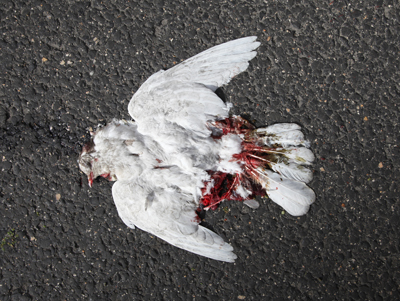
As an atheist, I am without the comforting option of any kind of belief in an eternal afterlife.1 I know—or certainly believe—that when I die, my mind and my various brain functions, such as thought and memory, will cease along with my bodily functions.2 I will not ascend to some other sphere as a discorporate spirit or psychic wave or sentient vibration. I—the part of me that thinks and plans and hopes—will quickly disappear into darkness. I will not sit on a cloud and look down on this world, on my surviving friends and family, or on any part of my reputation that might live after me, and feel anything positive or negative about them. I will not care. I will be as dead as roadkill, or a tree fallen in the forest, both of which eventually return to dust and their component atoms, leaving no discernible trace in the world. And in a hundred or thousand years, my life will have just as much meaning as that tree or animal among whatever passes for my distantly related family members or Western civilization itself. “Dust thou art, and unto dust thou shalt return”—body and soul, or so I believe.

You might believe this thought would be terrifying. That being nearer to death now than at any time in the past—when, as a younger person, I could cheerfully forget or ignore my mortal nature—would make me dread and fear those last minutes, make me scramble around in this life, frantically trying to put off death and preserve every hour, every minute of breathable viability. Or that it would make me rush out to experience every possible moment of joy or passion or novelty this life still has to offer. But that is not the way.

I am the same person I was up until February of this year: measured, thoughtful, introspective, and curiously unafraid.3 I am unlikely to become panicky or rushed just because the death that was always near has come a little closer—but then, ask me again five minutes before the final exit.

From this vantage point, however, I find death is not so scary. In fact, it will be something of a relief.

For one thing, I will find freedom from responsibility. It seems my life right now—and for all the years before this—has been an endless and widening cycle of responsibilities. These days, I must gather and protect my financial resources, because I am unlikely to earn any more against the future. I must pay my taxes, my condo dues, my ongoing debts—even though I try to pay the latter down every month and am careful about incurring more. I must care for my family members—in these days of coronavirus more in spirit than by my actual presence. I must walk my dog four times a day, following along her trail of smells and sniffs, because we live on the twelfth floor and I cannot just open the backdoor to let her out into a protected yard.4 But these are just my largest responsibilities today, and they are shared with almost everyone in my age group.

In my own particular makeup, I have lesser responsibilities that have been with me since childhood. Most are the residue of a lingering obsessive-compulsive disorder; the rest are the result of my upbringing by careful parents. I keep straightening pictures that go askew, as well as area rugs—which must align with the pattern in the parquet flooring—and the corners of my piles of books and magazines. I keep wiping, cleaning, polishing—caring for!—surfaces and finishes. I keep my clothes neat and clean—although I don’t iron them anymore, thank you. I must keep the car neat enough to entertain guests, as well as gassed up, serviced, and ready to roll. I do the same for the motorcycle, plus wipe dust off the shiny surfaces every time I take it out and clean bug splatters every time I bring it back. I worry over every scratch and stone chip in the paint, and chase every blemish with a dab of clearcoat followed by polishing compound. I wash and wax, where applicable, relentlessly.

For another thing, death will release me from the need to be and stay strong. It was the way I was brought up—as I suppose with most of the children in my generation. We were taught by parents who had gone through the Great Depression and World War II themselves to be resilient, enduring, patient, and uncomplaining. When work would get hard or complicated, and I would have to stay late or come in over the weekend, that was simply the price of being an adult. The inconvenience of a head cold is not stronger than the daily pattern of obligations, nothing about which to stay home and pamper myself—certainly nothing to deprive the dog of her walks and for me to resolve to clean up any messes she might make indoors. When my back goes into spasms—as it does in the cold and damp weather—and bending over is hard, that’s not enough to make me stop filling her water bowl, or leave a piece of lint on the floor, or let a rug remain askew. The pattern of life, as established, is more important than its minor disruptions.

Putting up with pain and inconvenience, suffering through that which must be endured, walking with back straight and unbowed into the whirlwind—this is the price of fulfilling my own self-image and the precepts that my parents followed and taught my generation.

Death, when it comes, will be a release of self from the web of life. Even if that is without the option of an afterlife, it may come as a blessing.

1. See, for example, My Idea of Heaven from July 22, 2012.

2. However, brain function may persist for some seconds or minutes after the body stops working. The story is told of Anne Boleyn, whose decapitated head, when held up for inspection, looked down on her severed body and moved her mouth as if speaking. We also know from extensive medical experience that brain cells can survive and be revived without irreversible damage for three to six minutes after the blood stops flowing. We do not die all at once. But those mere minutes are not a basis for belief in eternity.

3. See also Fear Itself from June 10, 2018.

4. But hey, it’s good exercise for me, too.

Sunday, June 28, 2020

The Antifanatic

Apple tease

Everyone these days is talking about “Antifa,” the “antifascists,” who enforce their views with bricks and fists. Well, I have a cure for that. It’s the realization that no one is morally or ethically or humanly required on any and all occasions to speak out, speak loud, speak proud. I call it the “Antifanatic.”

The call to action—putting your heart and soul into discussion or pursuit of a particular proposition—is all too often the call for absolutism. Distinctions are pared away. Qualifications are eliminated. Shades of gray are painted over. The pursuer—or defender—is left with a nice, clear, easy to understand, impossible to refute “yes” or “no.” Everyone is either with us or against us. Do or die. Death or glory. … And this is a remarkable renunciation of the human capacity for reason.

That said, you don’t want to enter into hard battle, a shooting war, life or death, fight or flight while you are beset by doubts. When the bullets are flying your way, you don’t want to be—and you don’t want those on your side of the trench line to be—questioning, maybe, your responsibility, just a little bit, and your moral justification for receiving those bullets. When war comes, you put your quibbles aside and take up the gun.

But not every social situation is a war. Not every injustice is a cause for rebellion and revolution. And that seems to be the problem today, in our politics, our economics, our culture, and our social connections. Every issue rises to the level of New York Times 48-point Cheltenham Bold Extra Condensed all-caps headline font, usually reserved for a declaration of war. The volume is turned up to twelve on a scale of ten. And so distinctions and qualifications drown in the noise of drumbeats.

I say this because most of life is gray. Living is a matter of distinctions and qualifications. Choices are seldom “yes” or “no” but more a case of “better” and “worse,” of “maybe” and “it depends.” In very few cases is the benefit or the risk absolute but rather a matter of calculation. And that is what the human brain was developed for, after a million years of deciding how to live in the world. In the hunt, there is no perfect knowledge and no obvious choice. Instead, the game may be in sight but at just a bit too long distance, or with the wind or foliage causing interference. There is seldom a perfect moment for the shot, just a collection of perceived opportunities and risks. And in the gathering of foodstuffs, there is no single, perfect berry or tuber to be chosen and plucked, only a selection of those on either side of optimum size or ripeness. How willing a person might be to eat an overripe apple, and maybe eat around a spot of brown decay or maybe a maggot on one side, depends on how hungry that person is. Circumstances and perspective are everything.

But it’s hard to get a political movement or a religion—and these days they can often be confused—started with an overlay of rational analysis, the weighing of distinctions and qualifications, the necessary consideration of “maybe” and “it depends.” The political leader wants his followers to shout “Yes!” The pastor wants his congregation to give a big “Amen!” That’s how you build a compliant crowd—by paring away individual thoughts and distinctions and cutting away any middle ground.

As a writer, I do not have the luxury of retreating into absolutes, of indulging the human craving for pure black or pure white, of sliding into absolutism. The writer’s job is to see multiple viewpoints, or so I believe. My characters are not—should not be, cannot be—creatures of simple tastes and absolute beliefs. My heroes need to have doubts and failings. My villains must have thought and reason.1

Every human has a story. Most humans—except those who were mentally impaired to begin with, or have lost their minds through fever, dementia, or other illness—have reasons for their choices and actions. The story may be tragic and leave the person bruised and selfish. The reasons may be faulty and the choices hasty. But those are all clues to character. Every human being is a ball of string set in the glue of circumstance and opportunity. And it’s the writer’s job with an imagined fictional character—or the psychiatrist’s, with a real patient—to untangle or cut through the string, to see how the glue seeps into the layers of choice and desire, and to find the main strands of personality. This is the excitement of exploring a character as he or she navigates the obstacles of a plot and action.

The fanatic would dismiss all of this discernment and analysis as irrelevant. The fanatic pushes a single thread, a single viewpoint, to the edge of absurdity—and sometimes goes right over into virtual madness. Any position taken as an absolute will lead to absurdity. In a world of “zero tolerance” about personal weapons, a nail file or a butter knife becomes a verboten possession. In a world of absolute support for a woman’s right to choose, strangling a baby at birth becomes a reasonable option. In a world of absolute justice without compassion or mercy, a man can be hanged for stealing a loaf of bread. Fanatics always end up defending positions that any reasonable person would find questionable, unjustified, and sometimes abhorrent.2

Reason is the human birthright. The ability to think and act as an individual, rather than as part of an arm-waving crowd, is every person’s prerogative. This is why human society is so varied and diverse: we each see a different set of distinctions, shades of gray, opportunities and obligations, benefits and risks.

Let’s keep it that way.

1. This is one reason I don’t write fantasy. It’s too easy to paint the villains as mindless evil for evil’s sake. Even a psychopath or a sociopath has a background story and a reason for his or her choices. In The Lord of the Rings, for example, the titular character and driver of the entire story line, Sauron, is never shown as a viewpoint character or even as any kind of living presence. Sauron is pure evil, malice without reason, power for power’s sake, the dark cloud that stretches in the east. We never get inside Sauron’s mind because there is no human mind there, just the darkness. This is not a failure on Tolkien’s part, but Sauron is the one character in the whole saga who operates without a discernible motivating cause and cannot be mistaken for human. Sauron is the fire, the storm, the mindless force of raw nature, not someone with whom we can identify—or bargain, negotiate, and reach agreement.

2. One of the reasons I am not a serious collector of things—stamps, coins, Hummel figurines—is that the initial attraction and the “Hey, neat!” response of the beginner eventually becomes the feverish pursuit of the rarest, least obtainable, and sometimes the ugliest or most flawed member of the defined group. (This is because ugly or flawed things usually don’t get produced in large numbers. Cf. the U.S. “Inverted Jenny” 24-cent airmail postage stamp.) I want to preserve the beginner’s initial fascination and avoid the fanatic’s ultimate heartbreak.

Sunday, June 21, 2020

The Static Viewpoint

Perspective

I sometimes wonder if the average human mind, born and raised into a particular place and time, has actually caught on to the reality that everything in life, the universe, and your own personal patch of ground is changing. All the time. With or without—usually without—your help. We all live in a kinetic universe. So get over it.

The adjective static and its noun form stasis come from Latin, which derived it from Greek, meaning “to stand.” And since this is not standing up or sitting down, rising or falling, coming or going, or moving from place to place, it implies “to stand still.” Everyone is guilty, depending on the subject and the circumstances, of thinking that the world around them hasn’t changed or won’t change, or when observing the change for themselves, hoping that it will eventually reverse and things come back to being the same.

To start with, most parents are by turns amazed and disappointed when their children grow and develop from cute babies to fretful toddlers, to winsome seven-year-olds, to moody, snarling teenagers. We want them to stay at each biddable stage and not progress. Sometimes they grow up to be adults we recognize and with whom we can become friends. But sometimes they grow up into strangers and even enemies. This is the pattern of life. And wouldn’t we hate it if our child failed to develop, through autism or some intellectual or emotional disability, so that he or she remained a charming imbecile, or a ranting child, in an obvious adult’s body? That would be the tragedy.

You can see this penchant for static thinking in the heritage of the oldest religions. The world of gods and men is fixed and unchanging. Yes, there are storms and earthquakes, wars and plagues, all of which change the fortunes of individuals and families, but the nature of the world itself remains static. You see this most plainly in the creation myths, where the supreme deity creates the land and the animals and plants that live on it, and they are all one-offs. A horse is the representative of a fixed pattern—essentially the Platonic idea of horse-ness—that was set at its creation and named as “the horse.” Yes, there are obviously related animals like donkeys and zebras, but they, too, were supposedly singular creations. And the horse is designed from scratch with teeth and stomach to eat grass and with neat hooves to run over the gentle turf in valley bottomlands. Just as camels were designed from scratch with floppy feet to walk on shifting sands and with water-retaining flesh in their humps to survive many days between drinks.

Of course, the religious writers and theorists of two and three thousand years ago did not have a true appreciation for the age of the Earth. For them, creation was just a few hundred generations ago, at most, or perhaps a few thousand years in the distant past. A world that cooled out of the solar disk four billion years ago would have been a thing beyond their understanding. Usually, they did not even have words and concepts for that large a number representing that long a span.

They also did not have a conception of tectonic forces, as I have noted elsewhere. If your world is just a few thousand years old, then you don’t ponder too long on the fact that you can see hills slump down in continual landslides, and mountains erode into silt and wash out to sea, and yet you don’t wonder why, over time, all the mountains and hills have not become flat. While you can see the agents of erosion and collapse, you never see the forces that built up the mountains and hills in the first place. It’s only when you have an appreciation for the great age of the planet and a working theory of plate tectonics—which wasn’t widely accepted until the 1960s—that you can understand the vast changes that take place over time on any part of the Earth’s surface and the necessity for all of these “created” life forms to have some mechanism for adapting and evolving to fit their current environment.

But antique religious explanations are not the only place that static viewpoints are held and nurtured. Political thinking of many types is bound up in the notion that the world and human consciousness does not or should not change.

Most obviously, there is the “conservative” view. It is a truism that conservatives1 favor tradition, that we are not offended by the vagaries of recent history, by the values we were taught and grew up with, or by the world as it presents itself to us. We are not ready to throw all of that—our parent’s world, or Western Civilization, or political values that pertained before we were born—away on the promise of a brighter, or at least different, and perhaps utopian future.

Conservatives are not always backward looking—or “reactionary” in the words of Marxists and Hegelians, meaning opposed to the just and natural evolution of liberal human thought. Conservatives can view the future with equanimity and a certain amount of hope. But we also know that history is not a just-so story, that it does not always bend in a particular direction, or not always in the direction that certain political parties—followers of those 19th-century Marxists and Hegelians—believe to be natural and inevitable. Conservatives can understand that history, and much of reality, is cyclical: ideas, political movements, economic and political conditions and parties, rise and fall against a background of human nature that has certainly evolved over many generations but is unlikely to change much from one generation to the next.

And then there is the stasis of the political left, the so-called “progressives.” They may believe that human nature is malleable and can be bent in certain directions toward idealistic perfection. But in the economic sphere, they clearly believe that a country’s goods and services, its money supply, and its scale and rate of personal and business transactions are all fixed. They believe the economy is a zero-sum game, where one person wins and prospers only through another person’s loss and misery. If one person grows rich, then he must have made a number of other people poor in proportion. As I have written before,2 the economy is not a pie, where if I take a bigger slice you must then get a smaller one. Instead, the economy is an ecology, where the more life that exists and more transactions that take place, the more wealth is generated for people to garner and to hold onto or share. The difference between a rainforest and a desert is not simply the amount of rain that falls, but the scale of interactions taking place on the ground and in the forest canopy.

And then, in the natural world, the progressives believe that conditions are—or should be—fixed and unchanging. They revile “climate change,” which also runs under the heading of “anthropogenic global warming,” because without humankind’s burning of fossil fuels and other environmental insults, they believe, the world would not change around them. They view a rise in global temperatures by a few degrees centigrade in a hundred years as an absolute catastrophe, missing the point that global temperatures have been rising steadily since the Maunder Minimum—a blank-faced Sun blank lacking in magnetic disturbances and sunspots—in the 17th century. They dismiss any historic temperature fluctuations—the Roman Warm Period, the Dark Ages Cold Period, the Medieval Warm Period, and that Little Ice Age starting in the 1600s—as a political fantasy. Similarly, they believe the sea level won’t rise without anthropogenic causes, as if shorelines haven’t been shifting, advancing and retreating, causing the relocation of city centers and populations for millennia, if not centuries.3 They also believe in a fixed amount of resources—such as Malthusian famines and “peak oil”—in relation to human population growth and density.

And finally, progressives appear to believe that, once they have achieved their goals, once human nature has been adjusted and perfected, society is ordered according to rational and egalitarian principles, and the world is led by like-minded professionals, then history will stop. That humankind, having reached the socialist or communist utopia, will cease to change and will simply roll forward, from one five-year plan to the next, in peace and personal safety, forever. For any thinking person, this idea is as narrow and stultifying as the religious conception that when we die we migrate to a place of either perfect bliss or perfect torment and reside there, as a disembodied but functioning and remembering consciousness, forever.4

Disbelief in and fear of change are written into most of the human experience. Change that we do not consciously plan for and initiate engenders the unknown. We believe we can plan for the future, and so a future that is moving ahead without us creates anxiety and dread. This is the product of having an active, thinking, projecting mind—the workings of the brain’s prefrontal cortex—that tries to meet an active, changing environment with an unknowable future.

And that, too, is part of the human condition.

1. Consider the very nature of that word, conservative. It means someone who “conserves” or “preserves.” A conservator is one who enters into another person’s life—when this person’s health or mental condition is failing—and helps them preserve their living situation, their wealth, and their dignity. To conserve something is to protect it and keep it from the ravages of time, the vicissitudes of nature, or careless waste by thoughtless humans.

2. See, for example, It Isn’t a Pie from October 3, 2010.

3. As if 11,000 years ago—well within the experience of modern human beings—the glaciers did not cover North America in ice a mile deep, and the shoreline did not extend down 400 feet to the edges of the continental shelf, all without human intervention.

4. And isn’t “forever” itself a static concept? Nothing is forever.

Sunday, June 14, 2020

Seeding the Stars

Starfield

I have already written about the ubiquitous nature of DNA on this planet,1 how every life form we can find—plant, animal, bacterial, and so on—uses the same basic replication system no matter how distantly isolated or temporally antique that organism may be. DNA is so successful that it may not have evolved on Earth at all. And that raises the question of how an intelligent species goes about adapting its kind of life to the different kinds of planets likely to be found in nearby solar systems.

In James Blish’s The Seedling Stars from 1957, scientists from Earth visit various exoplanets, sample their environments, and then genetically modify human beings to exist and thrive under those conditions. Perhaps they will have to breathe a different atmosphere, or stand up under heavier gravity, or—in one case—live as microorganisms in a bacteria-rich puddle on an otherwise dry and barren planet. It’s an interesting concept: making humans adapt to the environment on the ground, rather than living under domes of tailored atmosphere or trying to terraform the planet to fit human needs.

But Blish’s story requires a lot of hands-on synthesis. The geneticists and environmentalists on the seeding ships have to do a relatively quick study of the planet, figure out all of its advantages and pitfalls, and then redefine the human structure in exquisite detail—adapting the entire respiratory or alimentary system, adding muscle mass, or—in the case of that puddle—reducing the structure to microscopic size. While the concept makes a good story, I can imagine that if the scientists were wrong by a few degrees of deviation or just a couple of genes, the adapted humans would fail to function or die out in a generation or two.

But then, as we learned in the Biosphere 2 experiment, it is extremely difficult to develop a self-sustaining environment with resident human beings that is not continuously replenished from outside. We can maintain a crew aboard a ballistic missile submarine that operates submerged for months at a time only by having it surface, restock, and refit its systems after every mission. Living that way on the Moon or Mars without a continuously operating and available supply line from Earth may be more of a challenge than we think. Setting up to live under domes on a planet light years from our home world will likely be impossible.

The best way to adapt an organism to an alien planet may be to start small and literally from scratch. Send in a hardy bacterium that has only a few basic requirements for temperature, water, and food. Let it mutate, adapt, evolve, and spread by relying on the remarkable ability of the DNA-RNA-protein system to mutate and thrive according to available conditions. And then see what kind of life form—perhaps as intelligent as human beings, perhaps only as intelligent as dinosaurs and dogs, perhaps no more intelligent than slime molds—develops after a couple of million or a billion years.

Since you wouldn’t be sending your own life form—with its already developed physical characteristics, intelligence level, and environmental requirements—to the new planet, you wouldn’t be staking much on the “humanitarian” value of the colony and its fate. You might not even know that the planet you were sending your probe microbes to was capable of supporting life in the first place. You probably wouldn’t bother if they were going to land on a frozen gas giant or a hell world too close to its star. But close observation and exact measurement is difficult at interstellar distances. You could be wrong by a few degrees of deviation and still be successful in gaining a foothold for life—maybe not life in your own physical form but something sharing your basic gene structure—on a new world.

The odds of complete success—creating a life form that has recognizable intelligence and the ability one day to communicate back to your home world—would likely be small. And the timeframe would likely be long, on the order of millions or billions of years. So you would not place a great deal of trust or effort in the success of any single seeding mission. That being the case, you would not send just one or two missions to the most obvious planets and hope for the best. You would make minimal investment in hundreds or thousands of missions.

You might not be sending your designated seeds of life inside sealed and monitored environments aboard expensive, guided rockets with their own navigation and braking systems, as well as some method for gently sowing your seeds upon arrival. Instead, you might just reduce your hardy bacteria to a spore state that’s able to endure and protect its DNA-RNA-protein system for a thousand or a million years in space, scatter it on a comet or carbonaceous asteroid, and fling it out of your own solar system in any likely direction. Eventually, it will hit some solid body. Possibly, the spores will find a conducive environment and germinate. And maybe one time in a thousand, those seeded bacteria will mutate, evolve, and spread into something like complex life.

Do I think that’s what happened here? Do I think that we—the advanced hominids of planet Earth, product of three billion years of evolution—are the long-lost colonists of some ancient race of intelligent beings who were attempting to seed the stars with microbial DNA? Is there any way to know?

Not really. But it’s as likely an explanation as any other.

1. See Could DNA Evolve? from July 16, 2017. This blog describes the ubiquity on Earth of the DNA-RNA-protein system, not just in its basic pattern or structure but also in its finest details—like the choice among the various purines and pyrimidines for its four bases, the three-codon reading frame, and the limit of just twenty amino acids it uses in protein synthesis. This replication system seems to have evolved here without any significant or lasting competition—or perhaps it didn’t evolve here.