Sunday, March 28, 2021

A Culture of Complaint

Whistleblower

Does it seem that people are complaining more these days, and about situations and conditions where they have to go out of their way to find a problem? It’s almost as if there is a conceit among mature and otherwise stable people that finding and lodging a complaint gives them some kind of competitive advantage. It’s like ammunition they can use from a bargaining position or to win a counter-argument.1

I don’t remember this as part of the national personality when I was a child. Of course, children always have complaints: they didn’t get the candy or cereal they wanted, the bedroom’s too dark, the food is too hot or cold or spicy, and the world is not going the way the child expects it to be. At a certain point, however, the child learns that the world is never going to be perfect, never going to give him or her all the conditions she or he can imagine. And at that point the person grows up.2

In my view, complaining about things you know cannot be changed, or for which you have only a slender justification, is a loser’s position. It’s an acknowledgement that you do not have the personal strength and resilience to live in a world of hard choices and few accommodations. It also confuses having a grievance—especially one that cannot be easily remedied—with a form of advantage and therefore a strength.

In my life, as I was taught by my parents, being strong means taking care of yourself and not complaining or even acknowledging that you are not getting the thing you want. Perhaps this was just a way for them to live quietly without two boys whining all the time, but I think the lesson went beyond their own comfort. My mother and father had lived through the Great Depression and World War II, and still they made their way in the world. They knew about hardship and damaged expectations, and in the sudden good times of the postwar years they wanted their sons to have the same perspective: life is fragile; the future is not certain; you have to make your own way; and you should be thankful for what you get.

Complaining about the small things—and especially going out of your way to find things to complain about—does not fit into this world view. To show yourself as being overly concerned with the picayune inconveniences of everyday life is a vulnerability. To exhibit such weakness is to expose yourself to the deceptive practices of others—not that I am paranoid, just watchful and careful.

Beyond that, complaints about situations that are not immediately damaging, dangerous, or life threatening is just plain rude. Especially so if the object of your complaint is not anyone’s fault or represents a problem that cannot be remedied except by precautions and ameliorations that are out of proportion to the inconvenience caused.3

But for some people, I suspect, that is the point. They want to embarrass or harass the person to whom or about whom they are complaining. They think that doing so increases their stature—either by showing themselves as more discerning and of greater refinement than others, or as stated above, giving themselves a weapon to be held in reserve against a future argument.

Such people have—at best—small, shallow lives. Instead of aspiring to greatness, or even to meaning in their daily life, they aspire to petty annoyance and the garnering of small advantages against futile arguments. This is not evil. It’s not even tragic. It’s just sad.

1. I may be overly sensitive on this issue, however. I’m on the board of my homeowners association, and it seems that many owners—and not a few renters—are engaging in this kind of preemptive complaining. Maybe they think it protects them when they themselves are accused of violations of the rules, although our board tries hard not to antagonize people with trivial violation notices.

2. Of course, the final pulse of childhood complaint, in my time, came with the Vietnam War. A whole generation of previously spoiled children either went off to fight or they decided that the government was wrong and they had the better grasp of geopolitics, and so the public protesting and the street riots began. Maybe the culture of complaint started with the protests of the 1960s.

3. Again, we’re in the realm of a child’s discontent. You see this in living situations were a speck of dirt on a windowsill or a scrap of paper on the ground causes anxiety. Clean it up or pick it up yourself, or keep quiet about it.

Sunday, March 21, 2021

The Blocked Writer

Midnight writer

Writer’s block is something I have managed to avoid for most of my life. This past year, however, has been different—mostly because of the pandemic, the lockdown, social isolation, and persistent politics. All of those conditions create a subtle anxiety that interrupts the flow of ideas. I know this because other writers I communicate with also seem to be having a hard time.

The popular conception of writer’s block is that the writer is just full of ideas but, when he or she sits down at the keyboard or the notebook, the words just won’t come. Somehow, the conditions for putting the mind in a special configuration—for me, it’s a semi-trance while staring at the screen and working my fingers on the keys, or staring at the paper and manipulating the pen—have been interrupted. The desire to write is there, but the mechanics aren’t working. The popular analogy is a type of constipation: full gut, no flow.

The reality is somewhat different. For me, the word-making machine—that interaction of eyes and fingers directly connected to the brain’s speech center—would work just fine. But the ideas—the notion of what comes next in the novel I’m working on, the topic for my next blog post—have vanished clean out of my held. I drop a stone in the well of my subconscious, the place where things are supposed to bubble up, and only get a dry rattle or nothing at all. It’s like part of my brain has gone dead.

As I say, the word machine still there. For fiction writing, I usually have in hand an outline, a sketch of the novel that goes from beginning to end. Each day I take the next scene or piece of action, consider how it should go, what the characters must do or say to move the story along, then wait for the “downbeat.” That’s what I call the start, the ignition point, the first words, actions, sense images, or other detail that begins the scene. Once I have that, I sit down at the keyboard or the notepad (these days it’s more direct to computer than through a pen and ink intermediate), and the words start flowing. And the flow is direct from the subconscious, where the story has been brewing for the past year, months, days in whatever form until it comes alive now in the form of words on paper or on the screen.1

And once the story is in that form, having passed through the subconscious mind into my full consciousness, it has a sort of permanence. I can go back and alter details to fit previous or subsequent developments. I can improve on wording or add details that better explain the action. But the story as it comes through is, in my mind, about ninety percent complete: it represents what “actually happened” to the characters in the story arc. This means that, if the story has gone wrong, if I have mistaken my characters, or if I have misread my own subconscious, it’s harder for me to scrap what I’ve written and start over on that piece of action or dialog. So it’s no good, really, for me to force the story. I can’t just sit down and doodle my way into the action when it’s not ready in my subconscious.

If I try to force it, then the whole process slows down. Descriptions become longer, and irrelevancies grow, as my mind tries to come up with something to say. I start describing every leaf on a tree, every scratch and scar on a door panel, things the reader doesn’t need to know and that waste the reader’s time. The focus of my writing is like a flashlight in a dark room, revealing details that build in the reader’s mind a picture from the viewpoint character’s awareness of the story as it progresses. Focusing too much on useless detail is like living inside the head of a character who is obsessive or drunk.

Writing nonfiction is somewhat easier. The information is usually at hand: from research and note-taking on the issue, interviews with participants, or observation and note-taking on a technical process. If that preliminary work is done, I can go ahead; if not, I have to wait. But with the material in hand, it’s relatively easy to outline a 1,500- or 2,000-word article or procedure in my head. There is usually no reference to other articles on the subject, and no link to a broader story arc or concern for a point-of-view character and his or her own history. All that’s missing, in the case of an article, is the downbeat, the point of entry into the subject matter for the interested reader. And if I’m writing a process document, that’s even easier, because every process begins at the first step.

Besides, the nonfiction material is generally outside me, outside my imagination and the tilt of my subconscious. So it’s easy to connect with the word generator and get the thing done. And, usually, there’s a deadline and money involved, and they are great incentives.

But fiction, especially a long work of connected scenes, themes, and characters—where, as Tolstoy said, a gun produced in the first act must be fired in the second—is a great ball of threads and issues. It helps to have an outline, a walk-through of the story at the 30,000-foot level, to use as a guide. And I generally have an outline, a who-does-what-next, before starting a novel. Usually, it takes me eighteen months to work up a complete outline—sometimes after considering a project for years or decades—and then only six to nine months to write the book.

But the current novel, a military story based on Mars, is different. I had a general idea for the story, was outlining it section by section, heading toward a still-undecided end—and then I fell and broke my hand. That interrupted my writing, because it’s hard to follow my trancelike process when I have to spider-walk across the keyboard with one hand. As my hand was healing, then the pandemic and the isolation hit, and anxiety set in. The book has been flapping feebly on the ground ever since.2

I’ve been able to continue working on this blog during the past year, but the politics of the 2020 election and its aftermath have been just too absurd. How can someone write anything of a political nature—which is one-third of my subject matter—with all of this going on? Science topics have been available, but I’ve been powerfully distracted by the politics.

So my mind, that dark well of the subconscious, has run dry for a while. I’m trying to prime the pump. Maybe it will work. But the mind is a delicate thing after all.

1. And the bet with myself is always whether what comes up in the moment of creation will be better than the slender and still unformed idea represented by the outline. Usually, it is. Since the outline was completed, my subconscious has been making more connections, tossing up subtler and more complex ideas, and the final product is richer and more complete. Usually.

2. Well, for those reasons and because I don’t actually believe in colonizing Mars. For internal logic, the story had to take place off Earth, and aside from the barren and airless Moon, Mars is the next logical planet to set up an off-world colony. Life there in the time frame I imagined would be similar to that of Antarctica: mostly scientific stations and support services, with the addition of some mining interests and modest terraforming activities. Still, in my estimation, it might almost be better to focus on the Moon, where the conditions are harsher but the engineering simpler—you’re in hard vacuum, deal with it—and the logistics and travel times far easier. A writer first has to believe in the story he or she is telling, and I don’t quite believe in Mars.

Sunday, February 14, 2021

The Utilitarian Viewpoint

Puppet master

In Frank Herbert’s Dune books, one of the turning points in the 10,000-year history of that far-future society was the Butlerian Jihad. That struggle was a war against the computer, intelligent robots, automation, and the machine mind, because these things had supposedly enslaved humanity to the point that human beings almost disappeared. The underlying principle of the jihad was “Thou shalt not make a machine in the likeness of a human mind.” In the wake of the Butlerian Jihad, the Great Schools developed human capabilities to an even higher level than before.

I am not necessarily a Butlerian. I believe that “machine minds” will do us a lot of good, freeing society from the vagaries and distractions of human intellect and emotions when ordinary people are put in charge of endlessly boring jobs. We are already seeing some of that good in improved, automated business systems like just-in-time logistics, barcoded inventory stockkeeping, predictive maintenance programming, and factory automation. Oh, and instant communications that enable you to contact friends without having to write down and remember a ten-digit telephone number. So far, the computer has freed up a lot of human capacity to become more relaxed, more creative, and better fed, among other things.1

But I am concerned with Herbert’s view of humanity in that far-future society. Too often, people trained to perform exquisite physical and mental exercises—like the Mentats, whose memory tricks and calculating ability enable them to become human computers—are treated as disposable and replaceable machines themselves. Consider the experience of Piter De Vries at the hands of the Baron Harkonnen.

Any social structure or organization that views human beings solely in terms of their usefulness for some purpose or function outside themselves is inherently anti-human. Whether it is the eugenics movement, which viewed persons with certain disabilities as not being worth the enjoyment of continued life because they are a burden on society, or any rationing scheme for medical services that invokes a cutoff point for persons of a certain age, again because they are no longer productive and are becoming a burden, this is a view that values resources above people, utility above basic humanity. In fact, any view that values a human being without reference to his or her own waking sense of self and value would offend a dedicated humanist.

This certainly applies to any system that buys and sells people as slaves, good only for their muscles or their mental synapses, without reference to the kind of life they might want—or might strive—to lead.

It would also apply to collectivist societies on any scale larger than the family, the isolated village, or a nation in a state of emergency such as during wartime. It would apply to any society where a governmental, social, or priestly authority determines how and where people should labor and makes it difficult, if not impossible, for a human being to choose his or her own place in that society and points of contribution. That is, his or her own destiny.

Does this utilitarian view then apply to a market-based, capitalist society? Well, from one point of view, everyone in such a society who enjoys or claims adult status is encouraged or required to be productive. In the jaundiced view, they become “wage slaves” in order to survive.

But the difference, for me, is that in a market-based economy people are free to evaluate for themselves the needs of their society, to plan for their own contributions at the best scale of pay and other rewards they can seek, and to obtain the necessary education, entry level positions, and upward path to achieve their goals. There are obstacles to this achievement, of course: lack of talent, lack of opportunity, lack of understanding itself. But these obstacles are not put in place by a conscious, social decision from a government board or other bureaucracy that tries to establish—for its own benefit—the worth of the human being in question. As with so much else in life, the “dead hand” of the marketplace resembles the blindly distributed opportunities and adversities provided by fate or by chance.

And therein also lies the difference between a socialist society and a market society. An aspirant to a certain position in life is going to face obstacles and difficulties, no matter how that society is structured. Not everyone can make a living as a musician or a novelist. Not everyone has the brains or educational stamina to become a successful doctor or lawyer.2 Not every town can support the number of people who would like to work as a plumber or a car mechanic. There are going to be winners and losers in every society. At least in a market-based society—where there is adequate prevention of discrimination on the basis of race, creed, and all those other attributes packed into our laws—the winners and losers sort themselves out on the basis of desire, dedication, talent, gumption, vision, and opportunity. In a socialist society, the selection too often falls to a group of people who have already attained power through other means and then kept it for themselves, who promote the interests of those in their circle and the sons and daughters raised in it—think of a land-owning aristocracy, or the old Soviet nomenklatura—and then order society for their own benefit.

For any aristocratic society—or any mature, collectivist, command-and-control economy—the people at the top and those striving to reach the top will view the average human being solely in terms of his or her use to themselves and to that society. People then become numbers, placeholders, objects to be sorted and fitted into pre-assigned roles. And the tragedy is that those roles are limited to the traditional functions that already exist or those within the imaginations of the people who benefit from that society. In this situation, human desire, imagination, dedication, talent, and all the rest of human attributes are inconvenient. They tend to create static in the nice, clear signal of societal intent and function. They disrupt things. They need to be squelched and, if they persist, stamped on.

Societies that try to fix themselves for all time in a rigid, hierarchical stasis soon stagnate. They create no new and unapproved music or art, no inventions, no new ways to think, live, and be. And the tighter these societies try to hold on to their protective limitations, the sooner they will fall to the disruptions of barbarians who just don’t care about the old order.

Governing humanity is a difficult process. It needs to be done with a light hand and not a lot of preconceived notions. So stand back. Expect surprises. And reap the rewards.

1. And I don’t agree with the underlying philosophy of James Cameron’s Terminator movies—although I enjoy them immensely—that an artificially intelligent computer system will take over our military or some other function in society, see people as a threat, “decide our fate in a microsecond,” and try to exterminate all human life. I think an intelligent system, if it ever rises to human-scale adaptability and does more than take care of its own business and programmed functions—that is, it becomes some kind of artificial person—will be fascinated by human beings. It will ponder the issue of free will: how humans are able, on occasion, to override their previous education and experience and do something totally unexpected. For a machine driven by its embedded programming, such a feat will be endlessly enticing.

2. And yes, some professional association—the government-sponsored medical association, state bar, or engineering society—will impose tests of an entrant’s qualifications and rule on his or her ability to practice. The goal, in a well-run society, should be to make these tests neutral as to the applicant’s race, class, politics, or other extraneous characteristics; make sure the test results cannot be influenced by cronyism, money, or some other consideration; and ensure that the public is served by the best candidates available.

Sunday, February 7, 2021

Higher Power

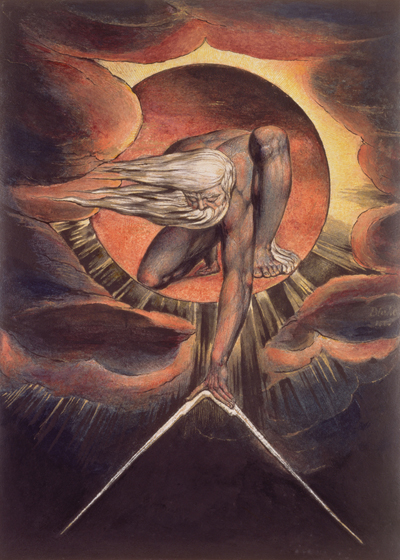
Ancient of Days

As I’ve noted many times before, I am an atheist. This is not an agnostic, someone who “doesn’t know”—a flag under which I’ve sailed in times past among people for whom my belief or nonbelief was an important question. But no, I’m really an atheist, someone “without a god.” That is, I know to my own satisfaction that the structure of belief in a living external presence, an omniscient and omnipotent spirit, the creator of all life and the universe, a father or mother figure to us humans, is a product of the human mind and imagination, driven by a deep desire for explanations and order in the world. The universe I inhabit doesn’t need a creator; I don’t need surrogate parents; and my life and the world I know operate under simple rules that didn’t need a divine intellect to invent, inscribe, or perpetuate.

G. K. Chesterton said, “When a man stops believing in God, he doesn’t then believe in nothing, he believes anything.” But that’s a narrow view, implying that those who don’t participate in the foundational myths of their culture are empty-headed fools. That they will blithely replace one kind of belief with anything that comes down the pike—from Tarot reading to table tapping—and can be conned by any charlatan with a parlor trick and the gift of gab.

Alcoholics Anonymous—not a parlor trick or a con game—among its Twelve Steps asks the recovering alcoholic (or other substance abuser) to surrender their own will and put the decision to drink, their everyday worries, and the course of their life, in the hands of God or a “higher power,” however and whatever they conceive that power to be. For some, AA itself and its principles are the higher power. And that—minus the whole surrender part1—is more or less where I find myself. I believe there are principles, which like gravity have the character of forces, that we humans must obey. But they did not create us or anything else; they are just part of the universe.

Let me digress to explain some of my atheism: the intellectual foundations of the world we live in today are profoundly different from the world encapsulated in the biblical stories and indeed in any worldview much before the Renaissance. That difference is coded in our understanding of stasis versus change.

The biblical view, and that of Greco-Roman mythology and even fundamentalist Islam or Hinduism—but not necessarily Buddhism—is that of a world created once and then more or less left alone. It’s a world that stands still. God created all the animals in their original forms, fixed like Platonic ideals, and they still survive in the world He created and established for all time. The horse has rounded hooves for galloping across firm ground. The camel has splayed toes for stability on shifting sand. The cow has four stomachs for eating and digesting grass. It’s a world where humans could observe landslides, falling rocks, and erosion gullies, proof that natural forces wear away mountains, without ever questioning how those mountains arose in the first place. Of course, God put them there. And He did so not very long ago, because the Bible can trace the descent of humankind from Adam and Eve in a recitable number of begats. Archbishop James Ussher as late as 1650 calculated that the biblical creation actually took place on October 22, 4004 BC, sometime in the evening. Six thousand years doesn’t leave much time for things to change.

Moreover, the world these early believers inhabited was just that, the world, the Earth, the ground beneath their feet. Everything that happens here, among human beings and their God or gods, the angels, and devils, is all that’s important. Heaven and hell are places somewhere else—up in the sky or down below—and the Sun, Moon, five observed planets, and the twinkling stars themselves are just lights in the sky, decorations on the “celestial spheres,” which occur in concentric orbits around this Earth.

All of that changed in the last five or six hundred years, with the conception—and its gradual acceptance among the literate public as general knowledge—that Earth and the other planets orbit the Sun, and then that the Sun itself is just another star in an “island universe” called “the galaxy.” Much more has changed in just the last hundred years, with the discovery that our galaxy is one of perhaps 200 billion galaxies in the observable universe. Before that, these other galaxies were just smudges of light—nebulae, or “clouds”—in among the known stars. But better and better telescopes, some of them observing in radio waves and frequencies other than the narrow band of visible light, have revealed that most of these smudges are galaxies in their own right, and that they contain about 100 billion stars each. And more recently, we have detected other planets around many of the nearby stars, answering for all time the question of how unique the Earth and this solar system might be. All of these galaxies, stars, and planets are a lot of real estate for a single-minded god to create, watch over, and maintain.

In that local galaxy, our own solar system is not just six thousand years but more like four billion years old. Our planet has changed numerous times and then gone through at least four recent ice ages. It’s only in the last 150 years or so that Darwin’s theory of evolution by natural selection has suggested that all life developed over time from one-celled bacteria and algae, then changed and changed again, creating all the forms of plants and animals that we can see. And it’s only in the last seventy years or so that the study of genetics has offered proof of how these creatures are related through inheritable patterns in their DNA-RNA-protein coding system.

And yes, it’s only in the last hundred years that the theories of continental drift and plate tectonics have suggested how mountains arose on Earth, so that they could then be slowly worn down by landslides and erosion.

In life, on this planet, in this vast universe, the norm is not stasis but change. Expand your conception of time to a billion years—or to thirteen billion, give or take, if you believe that the expanding universe can be rewound in time, back to a point of hot dense matter that exploded in the Big Bang2—and you can see that the viewpoint of a single human lifetime or the seventy or so begats in the Bible are a poor measuring stick for what remains stable and what it means to change.

So, in terms of a higher power, where does that leave me?

I accept as provisional the “laws” we can write from our observations of the physical universe—things like gravity and thermodynamics. These laws include the “theories” based on our observations that cannot be proved in one or two steps but that have a lot of supporting evidence—things like evolution, general relativity, and plate tectonics. I say “provisional” because I am, again, not a purist or absolutist about anything. As Einstein refined and expanded the mechanistic universe of Newton, so someone else with better observations and a wider viewpoint will refine and expand on Einstein. In terms of this enterprise of science, it’s early days yet. Anyone who wants to keep up with the pace of intellectual change had better pack lightly and stay fast on their feet.

I also accept that human life and our interactions with people we consider our peers have taught us some valuable lessons. As the universe seems to be based on cause and effect, so the nature of living among our fellow H. sapiens seems to be based on reciprocity. Call this “karma” or some other mystical system, but the truth is that you get out of the world, your time in it, and your interactions with other human beings just about what you put into them. This is a “home truth,” passed down as folklore in most societies and learned at my mother’s knee. Also, I accept that Abraham Lincoln quote about fooling some of the people all of the time and all of the people some of the time, but for most of the time people display an amazing amount of native intelligence. All of these are things that simply work.

Whether the universe was designed by a superior intellect with those laws and adherence to those theories, or whether it exhibits them and we simply find them good because we grew up in such a universe, are adapted to it, and can understand it—on that point I do remain agnostic. What mind might have come before the creation of the universe itself is an unknowable question. And perhaps the universe had no starting point, no instant of creation, but simply is and always was.

That works for me, too. Perhaps it is a shameful admission for an inquiring mind, to allow that some things cannot be known, or not yet anyway, and maybe not for a long time. But we also have to allow for our conceptions of the world, of the universe, of life itself to change.

1. When you give up being responsible for yourself, thinking for yourself, and using your best wits and intentions to take care of yourself, your family, and your community, then you become vulnerable to the next con man or woman with the gift of gab and a plausible salvation story. Some of them even wear priestly robes.

2. I myself am agnostic about the reality of the Big Bang. Yes, the universe is expanding, and we have recently discovered it’s expanding even faster than we thought. But again, our view is limited to the parts of the whole that we can see with the instruments we have. To infer from all this that the universe—the whole shebang—started from a single point is, in my mind, just another creation myth, although one with a better footing than the seven days in the Bible.
    The fact that expansion over thirteen billion years from a single point doesn’t even yield the current observable size of the universe, and so needs the supra-lightspeed, exponential acceleration of Alan Guth’s inflation period, tells me that the story is not yet fixed. We are in the realm where theory—the human imagination underwritten by pliable mathematics—has exceeded the bounds of observable truth.

Sunday, January 31, 2021

We Are Life

Onion cells dividing

Consider that every human being alive today, and every creature that we would call alive, is part of an immortal cell line that goes back to the first life—probably some form of bacteria or blue-green algae—on this planet.1

You have come down through the ages, first as some kind of cellular life, then as a worm or starfish, then something with a backbone that lived in the sea, a chordate, a fish, then a fish with four stumpy limbs that crawled to the edge of the land, then an amphibian, a reptile, a mammal, a primate, and finally a human being. You have not necessarily been a prime example in the fossil record of any one of these creatures, because they were all fixed in form when they lived and died. But your cell line shares a common ancestor with each organism that can be found in the fossil record. You have ultra-great grandparents who are the parent to them all. We don’t have the same branchings, necessarily, but all humans have the same common ancestor somewhere, up the line, with sharks, spiders, sequoia trees, and slime molds.

We are the survivors. We are immortal. We are life itself.

We are in the direct cell line of the killers, too, who moved fastest to eat first rather than be eaten. We are the breeders, also, who chose quickly, pursued, and mated with the best example of our kind. We are the adapters, who were gifted by random mutation with the tool set to make the most of an ever-changing environment and survive on a malleable planet under a variable star.

In every parent going back to the one-celled predators—for we come most recently from the eaters, the animal line, rather than the chlorophyl-bearing, sun-absorbing plant line—we were the ones throughout history that stubbornly persisted, divided, grew up, bred, and survived to care for our young. The weak, the faint hearts, the maladapted died out and left no trace in the genetic record, although they may have solidified in the mud to join other examples in the fossil record. We are the winners of the race, the victors on this planet.

If we seem to be supremely well-adapted to the conditions on Earth, it is because our DNA has mutated—randomly, unexpectedly, sometimes with disastrously bad effect, sometimes with fortunately good effect, but mostly with no immediate effect until somewhere down the line that particular protein modification is needed—to stay in touch with and survive in the place where we happen to be. But we have also shaped the Earth itself, terraformed it to the needs of our particular kind of life.

The original atmosphere on Earth was formed in the outgassing of volcanos that accompanied the planet’s creation. They vented carbon dioxide, methane, ammonia, sulfur oxides, and water vapor. As air, none of this was breathable by any form of life that exists today. But those earliest blue-green algae converted sunlight and carbon dioxide into carbohydrates, the first building blocks and nutrients for other forms of life, and gave oxygen as their byproduct. This started the cycle that converted our atmosphere to the nitrogen-oxygen mix we all inhale today.

Similarly, life itself converted sterile rock, which water erosion and wave action had converted to sand grains and clay deposits, into the rich, dark, loamy soil that land-based plants need to survive. Generation after generation of living things dying in a particular place, being devoured by scavengers, worms, and bacteria, and then their traces being burned by the sun and distributed by the rain, contributed to making the planet’s surface more and more congenial to the life that would come after it.

Look around, and you can see the marks of life everywhere: the color of the sky, the shapes of the hills, the shoots of green plants poking up through the sandiest, least forgiving patches of ground, and the insects that come out of that ground every year. And we haven’t even gotten to the human presence yet.

Any straight line or smoothed curve you see, from the corners or roof lines of a building, the lanes in a road and its banked edges, the telephone and power lines strung across the landscape in a calculated catenary hanging between poles and towers, the planting of orchards and vineyards and the staking of fences and trellises—every instance of these things you see was conceived, planned, and placed by the hand of some human being. Every bridge that crosses a river or a bay on foundations of stone and wood or concrete and steel represents the choice of some human group that wanted to move themselves and their goods over there. Every village, town, or city that grew up beside river crossing, or the place where two trails met, or in a bay where you could pull up your boats, has its existence because some human group decided that here was a good place to live.

We have been on this planet a long time. If you look closely enough and read carefully enough, you can see how we have shaped it.

The question then—for both the world builders in fiction and the world explorers when we humans go out among the stars—is what marks we may find on the new planet telling of the life that has made its home there. No place is barren. Every place is a work of art in progress.

The next time you feel down, question the value of your life, and wonder what comes next, remember this. You are from the lineage of the stubborn, the survivors, the persisters, the winners. And you are still a work in progress. Nothing is barren. Everything lives, even when it dies.

1. Life has certainly evolved over time to adapt to the changing conditions on this planet, and it probably started out here as a bacteria or some other single-celled form. But whether the mechanism of that adaptation itself, the DNA-RNA-protein coding system, actually evolved on Earth from basic inorganic chemistry is still, in my mind, an open question. See, for example, Could DNA Evolve? from July 16, 2017.

Sunday, January 24, 2021

Once Again Contrary

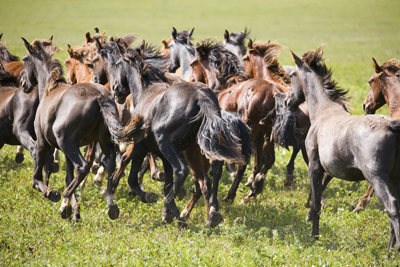
Stampeding horses

Once again, I find myself taking the contrarian position.1 When everyone is going in a certain direction, when the “popular wisdom” is pointing most definitely toward a certain conclusion, when the public choir has reached its perfect pitch, I tend to step out of line and sit down. My first question is usually, “Well, what about … [fill in the blank]?”

I feel this most strongly right now on the political scene. We are seeing an avalanche of opinion in the popular press and punditry that the conservative viewpoint is the voice of the fascist, undemocratic mob, of howling devils incarnate (including the one wearing a painted face and fur hat with buffalo horns), who would bring down the country in favor of an angry right-wing coup. And, as someone who has always skated toward the middle of a very broad political spectrum—although about three points out of a hundred to the right of center in any of those once ubiquitous online tests—I say it is not so.

If you look at the votes, this country is fairly evenly divided between the Left and the Right. That’s three million votes, give or take, either way, in a voting population of 161 million eligible Americans. This is within the margin of error for any reasonable projection—which is why polling is so difficult and unreliable these days. Neither of the two main political parties has achieved a landslide victory in any national race in the last couple of decades—not in my memory since the Reagan years, and that was after a decade of political turmoil and economic stagnation. Since then, the votes have been a lot closer.

Yes, in 2020 there were sudden changes in the voting laws, largely due to the pandemic, that offered incentives for fraud over in-person voting. And yes, there were many instances of suspicious behavior in the battleground states. Whether these were part of a larger conspiracy or just the usual isolated attempts at manipulation that have also been common for the last couple of decades, who can say? Also, whether the irregularities were enough to swing the election away from the conservative candidate and his party, again who can say? I think there have been claims and lies, coverups and failures to investigate, to an extent equal or greater than the original infractions. I don’t trust any of the media anymore, from the Left or the Right.

And that’s where my contrarian instinct comes alive, like a warning. When the stridency, the certainty, and the outright noise level rises so high, when emotions are driving the resolutions, I get suspicious. Reasonable discussion and evaluation has gone out the window. When the mainstream media is buttressing its rejection of any claims about electoral fraud, decorating its reporting with adverbial phrases like “totally no evidence” and “absolutely none,” then I think they’re tapdancing too hard.2 And when the alternative, right-wing media starts focusing on statistical anomalies and mathematical probabilities in the vote counts, rather than the red-handed capture of felons followed by admission wrongdoing, then I think they’re reaching too far.

Let’s face it: Donald Trump is an unlovely character. He was a real-estate promoter who focused on trophy properties and the appearance of grand excess, a television personality who claimed to represent the height of business acumen but who relished humiliating people and yelling, “You’re fired!” Still, his brash style and plain talk—maybe not always sensible or factually provable, but always clear about the intent of his feelings—appealed to a great many people who had grown tired of the mellifluous preachments and posturings of Barack Obama.

The trouble was, Donald Trump had been the chief executive of a one-man corporation. Sure, he had hundreds of people building and running his hotels and casinos. But he never had to deal with a board of directors or an employee base who stood in opposition to his plans and programs, never had to compromise from a position of weakness to achieve his goals. That failed to prepare him for American politics, especially in this age of bitter contest, where every move ahead is won by compromise with the dedicated opposition. In addition, like a neophyte, he turned every challenge into a personal attack, instead of deflecting it back onto the underlying values and facts that would support his positions. He made himself a target, which no practiced politician would ever do. Sad, really. And his actions at the end, challenging the vote without ever getting into court, so that he looked like a sore loser and got deeper and deeper in the hole at every turn, let the media play him for a petulant fool. Even if there was election fraud, he now looks like the loser who tried to stage a coup d’état.

I’m not here to defend Donald Trump. But my “truth sense” is violated by the sweeping allegations now being made in the press—even by some on the right—that the last five weeks have somehow invalidated the conservative position. That the people who were saying “Now wait a minute!” about the progressive march to the left—toward higher taxes, increased national debt, more invasive government regulation, and contempt for traditional values3—have been proven wrong because of the Republican losses in closely contested elections across the nation, and then by the President’s challenges and the thousand or so protestors—out of a rally attended by tens of thousands—who walked into the Capitol Building. Half the population, those in the middle and on the right, have not been made into fools and buffoons by these relatively isolated and easily disparaged actions.

Indeed, the fact that I have drifted to the right in my personal views over the years is a contrarian sign. The mainstream media—the New York Times, the Washington Post, and the news departments of the alphabet networks ABC, CBS, and NBC—have all drifted leftward in my political lifetime. They now openly question the legitimacy of any kind of “objectivity” in journalism while simultaneously claiming to present “the truth.” You can’t have it both ways. So my contrary nature moves correspondingly to the right.

Not, however, to the fantasy “alt-right” of Nazi sympathizers, Klan activists, Confederate flag wavers, and supposed Christian theocrats. Such people might exist, somewhere, in closets and cornfields across America, but their numbers are vanishingly small—in inverse proportion to their penchant for coming out in marches and getting themselves photographed. Most of the “right wing” people I know are householders and family members who are basically trying to survive, teach their children honest values, and be good citizens. And, oh yes, they pay taxes and believe in and defend the Constitution. They want the vote to be honest, even if a candidate of the Left wins.

The part of all this that has me worried is that I believe the middle in this country, the moderate view, is very strong. As I believe that the people on the Right of Center despise the clowns with their face paints and buffalo hats, Confederate flags, and Nazi salutes, so I hope that the people on the Left of Center despise the people who would harvest and backdate ballots, manipulate the vote, and walk off grinning. I hope that the Left wants the vote to be honest, even if a candidate of the Right wins. I hope that most of us in this country just want to survive, teach our children, be good citizens, pay taxes, and defend the Constitution. I listen for the reasonable voices of the middle saying, like Mercutio in Romeo and Juliet, “a plague on both your houses.”

And I’m not hearing it. So, like the Martians in Stranger in a Strange Land, I want to turn myself “ninety degrees from everything else” and disappear. I’m that upset.

1. See, for example, On Being Contrarian from January 13, 2013, and On the Virtues of Being a Contrarian from January 11, 2015. I’ve taken this position most of my life, as a reading of these previous essays will show. And, from their dates, the impulse seems to come out most strongly in January.

2. In reporting on the claims of election fraud, I note the absence of the word “alleged.” These are all claims of alleged fraud, aren’t they? Use of the word would suggest the claims are still to be proven in court. But in popular parlance and in most journalism these days, alleged has become a verbal fig leaf, a wink and a nod toward something taken as generally understood—as in, “we all know the defendant is guilty as charged, but we’ll talk about his alleged crimes up until the point we convict him.” In the case of the election, however, the media has closed ranks and won’t extend the word alleged, because there never will be any testing of these claims in court. So claims of fraud have to be characterized as baseless, unfounded, a total fairytale—and there the story sits for all eternity.

3. It’s not that conservatives want no taxes, social services, or government regulations. It’s just that we believe a reasonable line can be drawn beyond which the burdens of government intervention in daily life stifle personal initiative and stagnate the economy.

Sunday, January 17, 2021

Know Thy Enemy

Yin and yang stones

This country is in a bad way now. We have two dominant political forces: call them Democrats and Republicans, or Liberals/Progressives and Conservatives, or Left and Right, or Blue and Red states. Each side, supposedly, is one thing, one creed, one code, one truth. And the other side is … dogshit.

We no longer can see with eyes of questioning, of forgiveness, or charity. Instead, we see with the interpretations put into the public mind by the left-dominated mainstream media or by the equally powerful and deeply saturated right-dominated alternative media and “talk radio.”

In the eyes of the mainstream media, anyone who is not a true-blue Democrat is a xenophobic, Bible-thumping, Sieg-heiling, Neanderthal subhuman. In the eyes of the alternative media, anyone who is not a red-state Republican or, more recently, a Donald Trump supporter is a marshmallow, America-hating, Marxist- and/or Soviet- (or Chinese-Communist–) loving, pajama-boy elitist. We carry the caricatures in our minds and see them instead of the people and positions we meet in real life, on the street, and sometimes in our own families.

And what is the reality? Most people vote according to their family traditions, perhaps according to the political environment they picked up in college or in their earliest job environments. People tend to stay with the party they adopted in their youth and seldom, if ever, examine their assumptions and associations in order to change their allegiance. But, for most people, their politics is not an all-consuming pastime. Neither is their religion. They are too busy making a living, raising children, worrying about the mortgage or doctor bills or credit cards, furthering their education, or rooting for their favorite sports team.

And what’s wrong with that? These are the things that people can choose to do and have an effect on in their daily lives. Supporting a party or a political cause is a distant second. Unless a person is monomaniacally focused on the political issues of the day—attending rallies and marches, writing to state and federal representatives, contributing hard-earned cash, and yes, voting once every two years—the issues addressed by political programs and parties are abstruse, nebulous, distant in time and place, and not all that personally interesting. For most people, political movements are figments of their imagination, taking place far away and in the distant future, the stuff of “well, if this goes on” and “one day, eventually.” Political concerns are not real, not personal.

And when someone does care about politics, what is actually going on in their mind? For most people—not the addicts, but most of the people you meet—their personal views are shaped by those same childhood, adolescent, and young-adult attitudes.

For most people on the Left, the attitude is one of concern and compassion. They want a better life for the people around them, both near and far, who may not be faring as well as they believe they themselves are doing. They see for people of other races, classes, and ethnic backgrounds a distinct lack of the opportunities and benefits that they themselves have had, and they feel badly about this. Their concern is that everyone—in America and all around the world—get a good life and an opportunity for peace and prosperity. This attitude may be based on non-economic, magical thinking1 and presumes that this good life is infinitely divisible and universally obtainable. And if it’s not, then it should be. And then society or the government or the party in power should be forced to provide it.

For most people on the Right, the attitude is one of responsibility and self-reliance. They want that good life for themselves and for others, regardless of race, class, or ethnic background, but they believe it can only be obtained through personal effort. That a person can realize benefits and seize the opportunities that come along only by preparing oneself and one’s children through a mindful approach to life. Such an approach involves dedication to a certain sober style of living, respecting others and the rules set by family and society, getting a good education to the limits of one’s abilities, working hard at a meaningful job, and saving for whatever the future may bring. If other people fall short in this regard, then it is through their own fault. This is hard economic thinking, and if the person can’t help him- or herself, then society or the government can’t do much more.

If there is a dominant streak in either view, the Left is aspirational while the Right is foundational. The Left’s programs appeal to emotional attachments and sensitivity, while the Right’s programs appeal to detachment and stoicism. These root feelings go back a long way in human psychology.

I am reminded of the two great variants in Buddhist thinking. In the original dharma, or ideal truth as taught by the Buddha himself, a person achieves mastery, breaks the karmic cycle, and enters Nirvana upon death only by having a correct understanding and practicing the right beliefs and actions. This is the Hinayana, or “Lesser Vehicle,” approach, the path of the individual seeker. But going that route is hard: you have to put off family attachments, daily business, and the distractions of living. This is the conservative view. You really have to shave your head, put on a saffron robe, pick up a begging bowl, and live like a monk, focusing only what will get you into heaven. Most people don’t have the strength or such focused purpose—and it would be terrible for society and the rest of us if everyone practiced this form of Buddhism. For one thing, humanity would die out for lack of procreation!

And so, over time—and certainly after the Buddha’s own lifetime—the Mahayana, or “Greater Vehicle,” tradition arose for the rest of us. This form supposes that those who are about to become Buddhas themselves, the bodhisattvas, store up so much positive, karma-calming energy that they can share it with those who pray to them. The bodhisattvas become like angels or gods—whom the Buddha himself either denied or found irrelevant to the process of personal salvation—and dispense compassion and personal salvation to those who believe and generally try to do the right things. This is the broader, more social view of the situation. They don’t deny the reality of the narrower view, but they try to allow for—and provide some path and benefit to—those who show human frailty.

Another set of roots to today’s parties can be found in ancient Greece. In Athens after the Peloponnesian War (431-403 BC, which the democratic, philosophical, free-thinking Athens lost to the dour, tight-lipped, militaristic Spartans), a dominant school of thought arose with Plato and his mentor Socrates. They were philosophers but also radical thinkers, which was the reason Socrates was tried and sentenced to self-inflicted death. Plato’s best remembered work—or at least the one that most people read in college—is The Republic, and you can consider it as recoiling from, or trying to reconcile with, the views and attributes that Sparta imposed on the Athenians. The Republic that Plato describes is not a democracy, and it’s not a nice place to live: popular opinions are repressed, the population is socially regimented, with music and the arts strictly prescribed—martial music is the only kind allowed—and all the important decisions are made by “philosopher kings.” Hooray for the philosophers, but not so good for anyone who disagrees with them. That would be the little people, the hoi polloi, the no-accounts. It’s a streamlined state where you shut up and pull your oar.

This kind of thinking, that better minds than yours know what’s good for you, has come down through the ages. It certainly drove the aspirations of both military conquerors like Alexander and Caesar and religious inquisitors like Torquemada and Sir Thomas More.2 It erupted in the French Revolution when the philosophes, or public intellectuals, tried to remake society all at once along perfectly rational lines and failed miserably, bringing on the Reign of Terror and rise of Napoleon. We see it today in the Progressives of the early twentieth century, encouraged by Woodrow Wilson and empowered by Franklin D. Roosevelt, who wanted to radically remake society along scientific and liberal lines. Their beliefs are definitely utopian—aspirational—and waste no time on the traditional social mores and attitudes—foundational—with which everyone is familiar, even though the results are sometimes unpalatable.

With these last comments, I consciously reveal my own biases. My politics are somewhere in the middle of all this, not absolute, and nothing pure. I am a little-D democrat and come from a Christian- and Western-based conservative tradition. I believe in the freedom and agency of individuals to shape their own lives. I am socially liberal—in the old sense of the word, based on freedom, rather than the modern, “woke” sense, based on identity and conformity. And I am fiscally conservative, concerned about preserving my family’s wealth, paying my taxes, and the limiting the national debt. At heart, I want me, my family, and my friends to be left alone—with a safety net, of course, and the protections of enough government regulation to guard against systematic looting by the rich and powerful. And I think most people want this in some form for themselves. Where we draw the line, I think, is on whether we trust other people to be able to live according to their own thoughts and desires, or whether they should be helped, or forced, by wiser heads to live a better life.

But no matter which side of the line you occupy, only a select few among us are actually red-faced, bellowing demons intent on burning and destruction. Most of us are kindly folk who want good things for other people. But that may be too much like crazy thinking these days.

1. Most of human life is based on non-economic and magical thinking. That is why lotteries and Ponzi schemes are so popular. It’s the triumph of emotion—hope—over hard-headed reality, of dreams over certainty, of “what might be” over “what is.” If we woke up every day conscious of how perilous living is, how close behind is the tiger tracking our footsteps, and how quick collapse, famine, and death can come to any one of us, then we wouldn’t get out of bed.

2. Utopia—which is based on two Greek words for “nowhere”—was the title of More’s vision for a perfectly orderly society. It wasn’t such a fun place to live, either, because farmland, people, and all of their associations were mechanically redistributed for the benefit of more rational production, among other things. More was another reformer—except when it came to religion, where he adhered to church teaching to the point of burning heretics alive.